What stories about AI – and AGI – are we accepting as “normal” at this point?
I.
Imagine waking up at 4:00 AM in a foreign hotel. There’s a racket going on in the hallway. It’s impossible to sleep with all the commotion, and after grumbling a bit, you put on some pants and open your door. You’re not the only one: an entire hallway full of bleary-eyed guests are poking their heads out to see what’s going on.
Everyone around you is speaking a language you don’t know. All the guests seem concerned – a handful are jubilant. One of them points to an imposing concrete vault at the far end of the hallway. You catch, finally, some snippets of conversation you recognize: “it’s coming”; “who will it get first?”
Rubbing your eyes, you see that a small crowd is huddled around the vault with all kinds of tools. You muster some courage and walk down to investigate. More obscure chatter hits you from all directions as you walk, from strange and familiar tongues. What’s coming? you wonder. Is this an emergency?
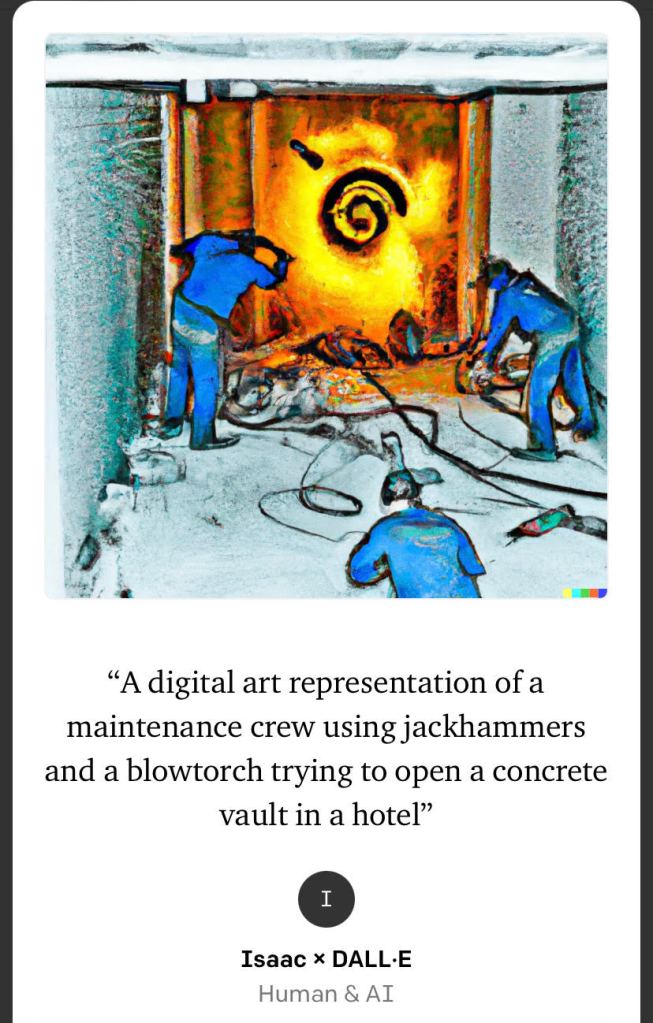
You get to the end. The entire maintenance crew is there, working away at the vault with jackhammers and hand-chisels and a blowtorch. The concierge is there, too – so is the doorman, and the bellboy, and the valet, and the fitness trainer. Several conversations are going on at once; none of it is intelligible over the noise.
You gesture toward the door and ask, in your halting attempt at the local tongue, what’s going on. You get sideways glances and cold shoulders from the crew until the concierge steps in and offers to translate. You begin:
“What are you doing to that door?”
“We’re opening it.”
“But what’s on the other side?”
“Something dreadful; truly gruesome. When we breach this door, a beast that lives on the other side will be loosed.”
“What will it do?”
“Oh, it will be a bloodbath, sir. Guests will be slaughtered in their beds. Joists will be ripped from the walls. The hotel itself will be a mound of rubble in mere minutes. We’ll be lucky if any of us make it out alive.”
“Why are you opening it?”
At this, you get a blank stare. You’ve made a dreadful faux pas; announced your philistine Americanness. Still, you need some clarity. You ask again. The concierge responds a little indignantly:
“Sir, why aren’t you opening the door?”
Baffled, tired, and horribly out of your depth, you abandon diplomacy. You scream, curse, gesticulate wildly at the maintenance workers, who by now have made quite a dent in the concrete.
The concierge, more amused than angry, wipes the spittle you’ve sprayed him with and responds:
“Listen, sir: just above us, the 16th floor is making significant progress breaking through the 16th floor vault. They may break through to the 16th floor beast by daybreak.”
Your face must register your bewilderment. He clarifies:
“How, in good conscience, sir, can we sit around, with our eldritch horror locked behind this vault, and wait for the 16th floor to release their eldritch horror and destroy this hotel as we know it?”
II.
My parable is a little on-the-nose. I’m sure, given the title of the series, you know what I mean by “the beast behind the door.” But if I were to extend the metaphor all the way, there’d be some updates. The guests, rather than stand mutely in doorways, would have been swarming the hall, placing bets and taking odds. Hustlers would pitch deep-pocketed guests in the hotel bar about “integrating the beast into existing workflows.” Very possibly, as some guests would surely speculate, there may not even be a beast on the other side of the concrete.
At least with my own experience grappling with A.G.I., the broad strokes line up. Nobody knows what the beast looks like; nobody, except for the hustlers (who’ve never seen the beast) can put a positive spin on it. Everyone involved thinks it’s inevitable – and, therefore, desirable? — that the beast is freed.
I believe there are people out there who truly welcome A.G.I., warts and all, who don’t also want to see civilization collapse. Transhumanists would be one group. “Post-scarcity” anti-work utopians are another. Some people are seduced by the idea of a “next step in evolution,” no matter the costs; I don’t totally blame them. I find them interesting. But they’re not the class that’s accelerating the quest for A.G.I. True A.I. boosters appear to possess, if not a double consciousness, at least a decent share of cognitive dissonance.
It’s of course possible to deeply fear an A.G.I. run amok, and still believe in the promise behind the concept. That, at any rate, is the guiding philosophy behind OpenAI (creators of DALL-E, ChatGPT, GPT-4, etc.). But we have a disparity in our stock of stories: AI promoters have built a solid canon of dystopian possibilities for A.G.I., and comparatively few visions for what A.G.I – a “new kind of mind” – could add to human civilization.
When we do hear the benefits of A.G.I., we hear variations on “automation.” Automation and its impact on labor are perennial concerns. What would this automation look like? It’s left unsaid. I’ll let ChatGPT give the canonical answer:

Does any of this sound well-defined? Unique? Note ChatGPT’s definition of A.G.I.: “a highly autonomous system that can perform any task a human can do.”
Any task a human can do is disingenuous. That’s not at all the same thing as a new order of consciousness, a new step forward for intelligence, of the sort that makes some A.I. boosters salivate (or wring their hands). A.I. taking over existing human occupations is one thing. If that were all we were talking about with A.G.I., we could cut the conversation short and say no thank you, we’d rather have full employment (or something close to it). The promise of A.G.I., if it’s going to be worth fussing over, has to be greater than this. Any task a human can do, as far as I’m concerned, is only the baseline for recognizing whether you’ve truly got A.G.I. or just a mishmash of really good programs.
And ultimately, as I’ve heard more and more laymen claim, this cataclysmic promise of A.G.I. may just be a strategy to drum up interest. And investment. It certainly gets people talking, and writing.
III.
“The man that invented the steam drill
Thought he was mighty fine,
But John Henry made fifteen feet;
The steam drill only made nine.“
Pete Seeger, “John Henry”
John Henry beat the steam drill. He persevered over an unfeeling machine built to replace him, through his own blood and grit.
The details of his life – even whether he was real – hardly matter. He triumphed; he became a legend. By now he’s become almost a pure archetype of human will in the face of automation.
It also cost him his life.
Strength – as in, brawn – is valued in the 21st century. Strength wins championships and wins places in halls of fame and record books. It’s a physical signifier of an individual’s discipline and work ethic, and often of a high level of commendable self-denial. But I don’t think any person alive would put up a modern John Henry against even the most rudimentary of modern machines. The most perfect specimen of human strength wouldn’t even be a bit player in a competition between standard-issue robotics in an average factory. We wouldn’t even consider holding up “strength” as the defining virtue of civilization.
So instead we say we have other defining features. Intelligence and its cognitive relatives – creativity, empathy, understanding, wisdom, et. al. What we lack in our physical comparison to “the machines,” we more than make up for with these distinctly human intellectual traits.
I think this is generally true. But before this year, I also never expected to have a productive conversation with a bot. Since then, I’ve asked ChatGPT – now considered lower-grade next to newer models – to write me a Socratic dialogue, and it did – in seconds. I’ve asked it to write me a screenplay full of French puns and goofy names and obscure themes, and it did, also within seconds. I’ve asked DALL-E to draw me some pictures – and, actually, it didn’t do very well with those. But my point stands.
What sets us apart – from the vegetable/animal/mineral kingdoms, but especially from machines of our own design – has to be found in our minds. That’s our stake to specialness in the world. And now something new has arrived. It “thinks”; it “empathizes”; it “creates.” Our John Henrys are raising hammers and laughing in the face of the “new steam drills.” They’ve won a race against a machine once before. But that was a long time ago.
“John Henry hammered in the mountain
His hammer was striking fire.
But he worked so hard, he broke his poor heart.
He laid down his hammer and he died.”
Pete Seeger, “John Henry”
 The Procrastinating Poet