• About The Procrastinating Poet
    • Articles and Other Writings
    • Contact
    • Posts (Archive)
    • Reading Log

The Procrastinating Poet

  • 2024: A Reading Round-up (and other recommendations)

    December 30th, 2024

    There is too much to say about the Year of Our Lord 2024 – too many moments of joy and tragedy, personally and geopolitically – so I’ll limit myself to writing about books and some other media.

    If you counted up the number of words that passed in front of my eyeballs in 2024, I think I read more this year than in any other. I fell well short of my goal for books but made up the difference in student essays and other “required reading” – or that’s what I’m letting myself believe. 

    The books I’d solemnly vowed to finish by the end of this year were crowded out by a mounting stack of overdue library books and others that demanded immediate attention. And there was a theme to this year’s reading that I wouldn’t have predicted this time last year. My end-of-year tally was unexpectedly heavy on new indie releases (for review purposes) and religion books (for personal reasons) and unforgivably light on poetry and fiction. In 2025 I hope (as always) to be more disciplined. 

    I have pet projects for the new year and some more serious ones. I’m still working through a stack of books I should have finished long ago (I know, “should” is relative, but many of these were assigned readings, so “should” is appropriate). Augustine and Kierkegaard are at the top. John Donne is up there too. The list is embarrassingly long. 

    In 2025 I want to finish all the parts of the Bible I haven’t yet read (and reread as much as I can of what I already have). It becomes more difficult to do the more seriously I take it. After that, I want to finish the Mishnah, the Quran, and the Book of Mormon, in that order – I’ll save my explanations for another time. 

    Looking back over the list of everything I read this year, I’m struck by how underwhelming so much of it seems. True sparks were fewer and farther between than in almost any year I have on record. That’s not to say I read no masterpieces – but somehow, on the whole, I don’t think I had nearly as much fun with these titles as I usually do. Perhaps I let circumstance and gut-instinct guide my reading choices too often, and I postponed too many books that would have genuinely captured my interest. 

    But I am unspeakably grateful to be alive and reading. There is much, much, much more to explore.

    Some highlights:

    Books

    Highly, Highly Recommended: 

    • The Plot Against America – Philip Roth (and the excellent HBO miniseries adaptation from 2020) 
    • A Sand County Almanac – Aldo Leopold 
    • Tom Lake: A Novel – Ann Patchett 
    • The Dearly Beloved: A Novel – Cara Wall 
    • Bad Religion: How We Became a Nation of Heretics – Ross Douthat 
    • The Marriage Portrait: A Novel – Maggie O’Farrell 
    • Summa Contra Gentiles, Book One: God – St. Thomas Aquinas (a surprisingly readable ease-in to scholastic theology)

    Most Beautiful Prose: The Poisonwood Bible by Barbara Kingsolver

    • Every now and then a book comes along that makes my writerly self despair of ever coming close to its triumphs. Kingsolver’s multi-decade narrative of an American missionary family in the Belgian Congo had that (not unpleasant) effect on me. Kingsolver masterfully juggles the voicings and psychological profiles of five very different narrators while telling an ambitious and genuinely gripping story of despair and change. This is not a perfect novel, but it is probably the closest thing I’ve read in a very long time. 

    Most Fun: Dracula by Bram Stoker

    • Everything has already been said about Dracula, so here are two quick thoughts. One: Dracula is somehow even more fun to read when you already know the major narrative beats; that’s the sign of a superbly-crafted, dread-inducing “slow burn.” Two: the comradeship formed between the book’s heroes in the second and third acts seems like a window onto another world. Maybe that’s my post-COVID, Millennial/Gen-Z isolation talking – but it’s almost inconceivable to imagine this sort of brotherly attachment to a shared higher calling cropping up very often among adults today. That level of bond may be limited to the military or the consecrated religious life. Perhaps the Victorians were more sentimental, or perhaps I need to get out more. At any rate: I’ll probably return to Dracula every October from here on out.

    Most Aggravating: Origin by Dan Brown

    • It’s a little silly to complain about a thriller that was published back in 2017. But the latest Robert Langdon mystery is a rare canker of a book that does something worse than bore its readers: it calls them stupid. Origin takes on religion as its subject – a scandal (as though The Da Vinci Code, Angels and Demons, and Inferno hadn’t done the same thing) – and never ceases to be impressed with itself for this decision. Brown treats atheism as a chic vanguard force in a European context that is and has been, by actual reckoning and reputation, thoroughly secularized. And the book’s central figure, Edmond Kirsch, is a creation that would have felt dated even two decades ago in the New Atheist publishing blitz. Brown’s characters are scandalized and spellbound in ways that would tickle their real-world counterparts. Worst of all: Origin spends most of its pages teasing an earth-shattering revelation – a revelation so profound that it launches the “world’s most brilliant religionists” into an existential headspin – and then actually delivers it. The revelation is piddling (a rehash of uncontroversial ideas about abiogenesis and a future “singularity”), but we get the sense that we’re meant to be as impressed as are the smartest people in Brown’s fictional world. And then our hero Robert Langdon, speaking as Brown’s stand-in, ends with a note of magnanimous “tolerance” for those (read: you and me) who may not be ready to face this brave new truth. I hate when books do this. And this isn’t even the worst offender I read this year. Origin makes me think that Dan Brown, for all his globetrotting, lives in an odd simulacrum of the modern world.

    Other media:

    Highly Recommended 2024 Films: 

    • Anora
      • Give it 40 minutes and you’ll find that this is not at all the movie you first walked into. This is a hilarious, heartbreaking, very Russian sort of black comedy.  
    • Back to Black
      • Musician biopics from Hollywood usually feel a little overcooked, but this one is grounded by serious musical talent and retains a certain authentic messiness. 
    • Between the Temples
      • On a budget of exactly $75, this team did something remarkably weird and (I’m going to use the term for the second time) heartbreaking.
    • Conclave
      • A little corny, and more than a little preachy (which makes sense) – but full of wonderful performances.
    • Dune: Part Two
      • There is no such thing as a perfect Dune adaptation. This, however, is a solid one. 
    • Furiosa: A Mad Max Saga
      • This was a hard sell (that nobody asked for), which made its triumphs all the more wonderful.
    • Longlegs 
      • Ignore the haters. It did overpromise in its ad blitz; it does fall flat in the third act when its mysteries are finally answered. But the first two thirds of this film are masterful horror storytelling.
    • We Live in Time 
      • Once again, I need my favorite word: “heartbreaking.” A quiet, humbling take on parenthood, commitment, and growing up. 

    Highly Recommended TV series (ones I first came across in 2024):

    • The Bear (Max)
      • The show’s third season may have been its weakest, but this is still far-and-away the best drama in the game. Almost unbelievably good. 
    • Civilisation: A Personal View by Kenneth Clarke (BBC)
      • Demands multiple viewings – this was my third time straight through from start to finish (while waiting for PBS to make a second season of their successor series Civilizations)
    • Rick Steves’ Art of Europe (PBS)
      • A sunnier take on the same ground covered by Kenneth Clarke. 
    • Country Music: A Film by Ken Burns (PBS)
      • I only just started this one, but it still has to go on the list.
    • Only Murders in the Building (Hulu)
      • I’m only two episodes into this one, but it already has to go on the list.

    Best overall series: The Young Pope and The New Pope (HBO)

    • Paolo Sorrentino’s baroque 2016 and 2020 miniseries may be the most important treatment of religious faith in popular culture of the 21st century. Overstatement or not, The Young Pope and The New Pope form a layered and beautiful narrative. Visual decadence and obvious clichés about piety abound, not always in productive ways, and Sorrentino is clearly in love with his own set pieces. Some of the subplots are more affecting than others. And as with this year’s Conclave, there’s an ultimately predictable (and dramatically uncompelling) softness that seeps in around the rougher edges at the narrative’s close. But even so: Popes Pius XIII (Jude Law) and John Paul III (John Malkovich) are some of the most interesting protagonists to appear on HBO or anywhere else. The story itself, thanks to the scale of the burdens shouldered by our characters, is as intense as anything in Game of Thrones or House of Cards. There are moments of this story that I believe will profoundly move any viewer patient enough to give it a try. The series have my imprimatur.

    Highly Recommended Albums (that I first heard this year):

    • Tom Petty and the Heartbreakers, Damn the Torpedoes (1979)
    • Fleetwood Mac, Tusk (1979)
    • Lou Reed, New York (1989)
    • Lucinda Williams, Car Wheels On a Gravel Road (1998)
    • American Football, American Football (1999)
    • Ryan Adams, Gold (2001)
    • Mk.gee, Two Stars & The Dream Police (2024)
    • MJ Lenderman, Manning Fireworks (2024)

    Recommended musical artists in general (that I first heard this year):

    • Charley Crockett 
    • Maggie Rogers 
    • English Teacher 
    • Dinosaur Jr. 
    • Son Volt 
    • The Carter Family 
    • John Fahey 
    • The Louvin Brothers 
    • Lonnie Holley 
    • Soul Coughing 
    • Superchunk 
    • Traveling Wilburys 
    • Mk.gee
    • MJ Lenderman

    Highly recommended podcasts (that I listened to most frequently this year):

    • In Our Time (BBC)
    • Dollar Country (WTFC Radio Lawrence Kansas) – thanks to Justin Randel for recommending
    • [Abridged] Presidential Histories with Kenny Ryan
    • Premier Unbelievable: Ask N. T. Wright Anything
    • The Jewish History Podcast with Rabbi Yaakov Wolbe
    • Lectures in History (CSPAN)
    • Humane Arts (Wesley Cecil)
    • Westminster Presbyterian Church at Rock Tavern, New York (sermons)
  • A (Belated) Defense of Cornel West

    December 20th, 2024
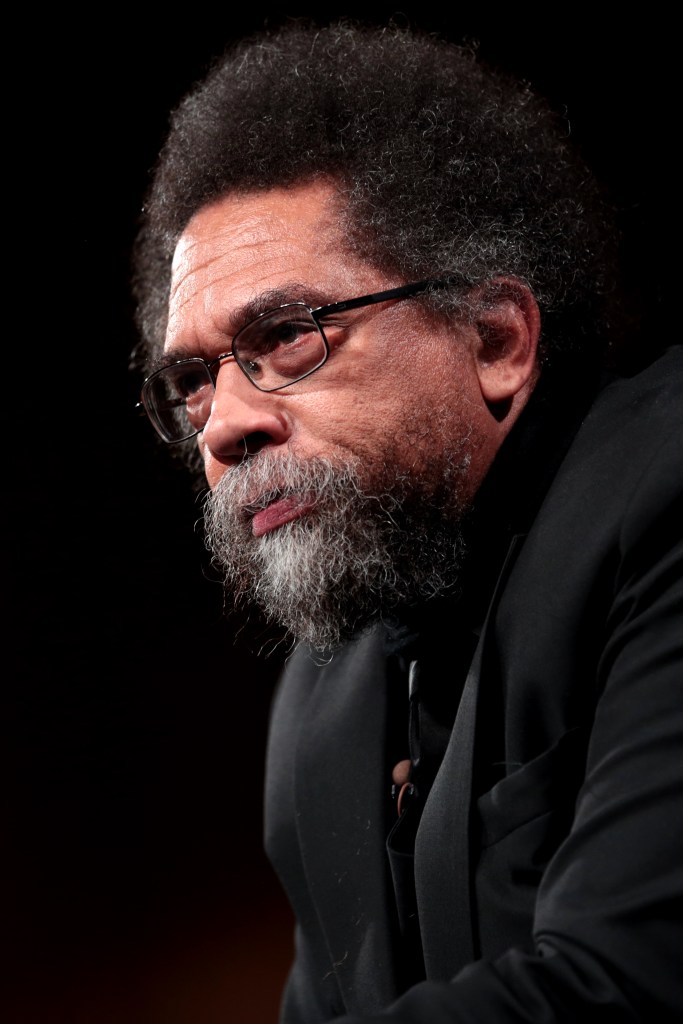
    “Cornel West by Gage Skidmore” by Gage Skidmore is licensed under CC BY-SA 3.0.

    About this time last year, The New Republic nominated Cornel West as their “Charlatan of the Year” for running as an independent in 2024’s presidential election. Now that that contest is up, it’s safe to say that West was a political non-factor among non-factors. His votes melted almost immediately into the nameless mass of 388,817 “Other Candidate” ballots, which is roughly half the total that Chase Oliver (?) took home. 

    The article was written by David Masciotra, whose incisive Exurbia Now I reviewed earlier this year. Masciotra is a thoughtful chronicler of the American Left and its metamorphoses over the last four decades, and his catalog spans an impressive range over American culture generally. He’s also faced dressing-downs in the past for his criticisms of West – since West, like many public intellectuals who’ve mastered the lecture and cable circuit, has no shortage of loyalists – and I have no business piling on. Masciotra’s critique, for the most part, is sound. I can speak comfortably from this position of hindsight, knowing now that West’s candidacy was never a threat to anybody, and say that perhaps Masciotra leaned a bit too hard on the man.

    Easy for me to say.

    I was only reminded of TNR’s article because I’ve been working my way through recordings of West’s 2024 Gifford Lectures this last week. This post isn’t meant to cover the logic (or illogic) of third-partyism – I want to write instead about West’s artistic side – but I will say a few things in brief. Yes, in the end, West was a non-player in the election, but even if he could have made a difference:

    • In December 2023, when the article was published, President Biden was the unquestioned Democratic nominee and was still a full seven months away from withdrawing from the race – a call that was almost unanimously affirmed even by his own diehard supporters. 
    • When the article was published, West was perhaps the only charismatic candidate on the Left launching any kind of “internal opposition” to Biden’s run. (Who else was there – Dean Phillips?) 
    • The threat of a serious electoral challenge from West may (in some alternate reality) have been one (small) part of a movement to reconsider Biden’s candidacy an entire year before that conversation actually took place, following “the debate heard round the world.”
    • Many Democratic strategists – the same who opposed West’s candidacy as the vanity run it may have been – now lament the lack of a “real” primary, and the lack of time for Harris’s campaign to get off the ground, blaming those factors for Harris’s defeat. A third-party challenge from the Left was, perhaps, one way to deal with these factors far enough in advance to make some kind of a difference.
    • Even if it never led to a shake-up at the top of the ticket, the purpose of a “spoiler candidacy” like West’s is not to win but to exert real pressure on the closest ally with the best chance of winning – and to get some kind of humane concessions from them before they dish up their usual tasteless election-year-milquetoast gloop.  

    Enough about the presidential run, which is the least interesting thing about West’s career even in the last few years.  

    Watching the Gifford Lectures this month (and several of West’s guest lectures from elsewhere) brought me my first sustained dose of West’s rhetoric. This was the first I’d experienced of West’s infamous web-spinning: his deep familiarity with, and playful references to, the canons of world thought – of philosophy, poetry, novels, plays, theology, and, importantly, music. 

    Now, a quick note to set up my next point: unlike many wonderful writers and scholars I know, I never had to be converted to the liberal arts. I’ve always bought into the corny platitudes that college recruiters shell out about becoming a “versatile thinker.” For as long as I can remember, I always believed that something tethered all the arts together; that there was some mystical union – some Platonic canon – that gathered together all forms of human expression over the ages, and that they really did and really could be held in conversation with one another – and that they all really mattered in the grand scheme of things. I’m not exaggerating when I say that this was, and still is, a nearly religious ideal for me. I won’t go into that here – only to say that this faith has been scattered over some very rocky soil in the last decade or so, both in and out of academies.

    West, of course, is from an older generation of scholars, and his lower-case-l-liberal use of the canon was probably not so unusual in the past. (I’m thinking especially of the High Romantic Harold Bloom, who sang a 40-year swan song over the waning of just this kind of hallowed treatment of literature before his death in 2019) West knows the literary greats intimately. But to hear West speak about other arts, and especially about music and musicians – jazz, the blues, John Coltrane, Curtis Mayfield, Nina Simone – is astonishing. It’s far different from the way that any other contemporary critics – at least the ones I’ve read recently – approach the arts.

    To take a basically random example, consider the cultural criticism of Mark Greif, the n+1 founder whose 2016 collection Against Everything covered Keeping Up with The Kardashians, Nas, “Octomom,” the lyrics of Radiohead, and other so-called “pop culture phenomena.” Here, as in almost every other example of “Media Studies” that I can think of, there’s an overdetermined, almost deadly seriousness to the treatment of the subject matter. The absolute refusal of “Media Studies” to make aesthetic divisions between what their audience instinctively recognizes as “high” and “low culture” sometimes feels like a challenge to the reader: What, aren’t you going to say anything about my Kardashians chapter? Not quite what you expected? Was that a smirk I saw there? I don’t think Greif necessarily wants this reaction – but at no point does the reader get the sense that these songs/TV shows/films/individuals are anything more than proxies for the writer’s own analytical flourishes. The attention is entirely on the writer’s brilliance: look at all the insights I can glean from the cultural detritus you, the common middlebrow reader, probably don’t even think twice about.1

    Not so when West caps off his tangents with a lyric from Curtis Mayfield. In short, West thinks these artists have something to say – their works are in conversation with Nietzsche and Chekhov and Lukács and Heidegger and all the rest, and not just in the pandering way that our disciplines use that term. They aren’t merely “cultural artifacts” or objects of “ethnographic study.” And therein, I think, lies one of the most vital effects of West’s public lectures: it actually allows the arts a place in the most meaningful conversations of history. 

    And one last note: West’s reading of Christianity – his unbelievably consistent insistence on the equal dignity and worth of every human life; his welcoming of even ruthless opponents as “dear brothers/sisters” – is a welcome thaw for the chilling hoarfrost of radical politics. It’s given him a universal conception of justice and solidarity that makes the factory-grade Marxism of his compatriots look provincial and clannish by comparison. His so-called “revolutionary Christianity” exalts the poor and the low-caste while leaving a space, even theoretically, for the publicans – the Lazaruses as well as the imperial collaborators like Zacchaeus.

    1. (Not a dig at Greif specifically — this is a generalized “I” shared by, let’s say, the broader discipline of “cultural studies”) ↩︎
  • “Whataboutism”: A Little Note

    December 19th, 2024

    After hypocrisy, “whataboutism” is the most vexing conversational vice of our time. And like hypocrisy, it’s almost impossible to criticize in good faith. None of us can dispatch a hypocrite bloodlessly – the sword of criticism cuts in both directions – and the “whataboutists” in our lives can count themselves safe on the same grounds. All have sinned and fallen short, etc.

    Even so, I think that “whataboutism,” as a reflex, however much it tends to infantilize our discourse, is worth keeping in circulation.

    The term “whataboutism” might literally have come from The Troubles of Northern Ireland, but it describes an ancient pattern with which we’re all familiar to some degree. It’s a more generalized application of the fallacious tu quoque argument, and its goal is the same: to avoid personal responsibility. When carefully used, it can serve a useful counter-cultural function. It can redirect public outrage from a minor sleight or gaff toward a larger, more deserving target. It contextualizes small breaches of decorum (and even ethics) by showing their place within a larger and more terrifying system.  

    That’s an occasional benefit. But more often “whataboutism” is a child’s toy that adults use to excuse the worst kinds of human behavior. 

    One egregious example: let’s say that a man murders another man in broad daylight and that the victim works in a deeply unsympathetic profession. Let’s say that the broader public valorizes the man who commits the murder and that the murder becomes a cause célèbre which straddles uneasily between the internet’s standard “post-irony” and a genuine appetite for bloodletting. Internet commenters who offer gestures of sympathy, caution, or regret for the murder are treated to long lists of the victim’s own actions over the course of his career. To return to the question of murder and to entreat our ordinary responses to murder is impossible: the broader public is more interested in scoresheets. What about…?12

    The list of possible examples is bottomless.  

    Whataboutism infuriates us because it challenges our power. We see our opponent equivocating, ducking, and dodging their way out of acknowledging the truth we want them to see. If they would stop moving for a minute, we could, as we do with misbehaving puppies, force their heads down into their own filth and let them stay there until they emerge whimpering and repentant. We are prevented from our exercise of True Justified Violence – and it makes us angry. 

    The only way out of this anger is to experience it from the other side. I can think of several examples of this, and you can too. You (or your position) are thrust on the hot seat; you (or your position) are excoriated for your participation in some evil; you (or your position) are given no escape hatch. Why me? Why this position out of all the others? Why now, of all times? What about…

    All have sinned and fallen short. Christians and the Soviets agree (correctly) that guilt exists everywhere, at all times, in everyone, and all it takes to find it in someone else is to choose to look for it. Every criticism of another’s shortcomings – intellectual, moral, or otherwise – is, on the cosmic scale, entirely justified. There is something there. Once we’ve got someone in the interrogation chair, we can keep them there indefinitely; their protests, on the cosmic scale, are weak and entirely unjustified. But who makes these kinds of calls? Who decides who ends up in the chair? 

    In a way, it comes down to who makes the first accusation. Whoever throws the first stone and lands the first blow is, for a time, safe from the same treatment. It’s a game of brute power.

    On the one hand, we are called to a life of radical self-examination; to hear our faults read back to us from others’ mouths should move us deeply. But on the other hand, we reserve the right to appeal to balance and proportion to preserve our sense of moral clarity. Perhaps this is “whataboutism.” Perhaps not. One does not preclude the other – radical responsibility is required us, while common sense tells us that flagellating our backs raw will leave us unable to shoulder the heavy burdens of the future. 

    It’s frustrating to see others equivocate and “whatabout” themselves out of meaningful criticism. It’s a problem that probably will worsen over the rest of this decade. But I think it’s a fair tradeoff when considering the other extreme: an endless series of ridiculous Puritanical3 tribunals headed by the worst and least generous among us. 

    1. Not to belabor the point here, but this is where common sense ethical judgments hold supreme. We reserve the right to say that something is morally wrong, and we reserve the right to be deeply suspicious of any calls to the contrary that cloak themselves in “nuance” and “complexity” and “a long history of [X]” (or, God forbid, “the revolution,” “the country” “racial purity,” “the intifada,” or whatever other excuses we make for others’ crimes). We oughtn’t chuck these questions to “the philosophers” when they seem beyond our reach – laymen too often discount their moral compasses, which often point truer north than those of their professional counterparts. ↩︎
    2. The point isn’t lost on me, either, that moral contradictions of this variety are the cornerstones of literature itself, stretching back to Aeschylus and Homer and deep into prehistory. Revenge, comeuppances, revolution, blood-feuds, and questions of the appropriate exercise of violence have jostled their way into most literary canons of the world, and they’ve produced some of the world’s most passionate (and even beautiful) philosophical and political writing. We exist in a world at war with chaos and the legion evils of human nature. But to acknowledge that violence has a draw on us and speaks to our deepest selves is not (as obvious as it may sound) to justify it. That we cannot help breaking the moral law is not a reason to give up on the moral law – it is all the more reason to hold fast to it. ↩︎
    3. I mean this, if you can believe it, without any disrespect to the actual Puritans. ↩︎
  • Antisemitism: A Hypothesis

    November 8th, 2023

    I write this exactly a month after the deadliest single day for Jewish people since the Holocaust. Up to this point I’ve put off writing anything about Hamas’s October 7 attack and the subsequent war because I know I won’t do it well enough. It’s impossible to honor the scale of human suffering in Israel and Gaza over the last month. And it’s impossible to avoid the mire of qualifications, understatements, false equivalence, and all the other noxious distractions that characterize our public discourse. I’ll try to keep my aim here very, very limited.  

    In recent years, even before the outbreak of the war, I’ve been shocked by the range of the coalition amassed around antisemitism: the usual fringe actors, but also agitators from the broader Islamic world; the post-colonial revolutionary wing of the Left; the racialized, “extremely online” Right; the resurgent Black Hebrew Israelites; Kanye West – and others. There was no top-down organization; it always seemed a grassroots phenomenon, spontaneous and stochastic and ecumenical in a way that few other ideologies are.  

    Next to everything else – and this is not at all the most important point to make here – antisemitism is unbearably lazy. It’s tedious watching people take it up as though they’ve discovered it themselves, and as though it were a mark of intellectual courage. In a literary/aesthetic sense, it’s ugly for the same reasons. An example: if I wrote a novel featuring a garden-variety 21st century antisemite, with dialogue taken verbatim from any of his flesh-and-blood prototypes, I’d be justly panned for taking part in such derivative and cliched world-building. It’s all been seen and said countless times before. The element of cliché in antisemitism – and the implausibly hokey, comic-book-villain nature of most of its manifestations – is puzzling for such an ancient prejudice.

    I have a hypothesis about why these cliches persist. In the liberal democratic West, and with good reason, antisemitism is one of the last remaining taboos in polite society. I don’t know, twenty or thirty years from now, if that will remain the case. The world is changing. But for now, children in the U.S. and through much of Europe receive a comprehensive primer on the Holocaust; we learn from an early age to guard against the species of evil that spawned it. Ask any American or Western European who was the single most detestable human to ever live, and you’ll almost certainly get the same answer.

    But the human proclivity to bristle against authority – to push boundaries, to be “edgy,” to slaughter sacred cows for a laugh – finds a natural target in the Jews. For a certain caliber of middle schooler, nothing is as hilarious, or as “brave,” as carving a swastika in the school bathroom. These kids (most of them, I’d hope) outgrow this urge when they outgrow spitballs and fart jokes. A charitable reading of human nature would hold that these kids “know not what they do” – that this isn’t really antisemitism, but preteen anarchy. 

    But hordes of others grow up, and, having never had a streak of contrarianism before, discover as adults the terrifying thrill of “unorthodox opinions.” I’ve spent more than a reasonable amount of time lurking in conspiracy circles online – Flat Earth, 9/11 Trutherism, and uglier stuff – and hear the same “conversion” testimonies ad nauseam: after a life of complacency (living as “sheep”), these individuals start asking the “real questions.” For this sort of person, there is no better “final boss,” no better shibboleth, no better badge of intellectual “courage,” than the repudiation of Jews as a protected class. 

    Every generation has its share of people like this – people who, having asked no meaningful questions during their formative years, turn into paranoid, impressionable adults who renounce every solid judgment they took for granted growing up. Taboos, they think, exist only to hide “forbidden knowledge” — why else would they exist? Why else wouldn’t THEY want you to poke around there? In the decades after the Shoah, when antisemitism in the West became anathema – again, only in polite society – the pressures against these expressions formed a perverse attraction for newly-minted anti-establishment types. 

    For the deeply anti-social (e.g. most Neo-Nazis) and for those under the strain of public psychotic breaks (e.g. Kanye West) – for people who strive for extremes of incivility – the anti-Jewish canon offers a ready stock of images and phrases to draw on. For as long as Jewish history is taught to children, children will grow up with a deep sympathy for the plights of the Jewish people. For as long as some of those children grow up susceptible to the thrill of cheap “gnosis,” they’ll continue to reject the sympathies of their youth, and Jews will bear the brunt of this. 

    Naturally this is a very shallow reading of a very old problem. I haven’t addressed the issue of deeper cultural inheritances, or the web of structural causes for the persistence of antisemitism. I’m talking about only a fraction of it – and specifically why the same cliches, the same “conclusions,” keep surfacing out of the same “benign” liberal cultural ferment. I’ll end this with another, and better, cliché: the price of liberty – including the liberty to express heinous ideas – is eternal vigilance. We need to be aware of the sort of world which our liberties are making.

  • Allhallowtide

    November 5th, 2023

    There’s a part of me – a nostalgic, desperate part – that wants to recreate in adulthood the sense of time I had when I was a child. For as long as I can remember my life has been measured by the American school calendar, a curiosity anywhere outside our borders.

    (A Danish guest at a family dinner a few weeks back was almost as shocked by this as by our systems of healthcare.)

    Millions of my peers have happily (or begrudgingly) discarded this for a “grown up” calendar built around vacation days and sick leave. If I stop teaching, I’ll need to do the same. 

    Grinches and overworked retail employees might point out that the “holiday cycle” is a euphemism for marketing campaigns. But that doesn’t matter to a child. An average child in the U.S. measures time in steadily increasing enchantments: the first day of school, Halloween, Thanksgiving, Christmas, New Year’s; a buffer, and then Valentine’s Day, Easter, spring break, and the long languid freedom that characterizes our summer breaks. 

    At some point this fades, and between the slow end of childhood and the dawn of parenthood, most holidays become strange: it feels a bit silly to celebrate them, but it feels grotesque to ignore them. I’ve made compromises with the minor ones: I’ll look for a sprig of green on Saint Patrick’s Day, give a solemn nod on Labor Day, think about trees on Earth Day, etc. – midnight passes, and I might feel a prick of guilt for my non-observance. 

    I hadn’t heard of All Saints Day (“All Hallows”) and All Souls Day until comparatively late. I was in grad school, living alone for the first time in my life, and the idea of a “feast day” was new and Romantic. I wasn’t Catholic, and didn’t know the rules, so I took a literal interpretation: one day, I assumed, celebrates all the saints, the other celebrates all the souls that are now, have been, and ever shall be. 

    I know a little more now. But I still like my first interpretation. Every “Allhallowtide” (Oct. 31 – Nov. 2) for the last four years, I’ve tried to “celebrate” these days in the awkward, private way I’m accustomed to with all the minor holidays. And I end up with an amalgamated mush of inward rituals: some confused prayer, some baffled reflection; once or twice, a piece of writing that never sees daylight. I take the days in their broadest possible meaning, transfixed by the sheer magnitude of that word “All.”

    Questions arise. Doesn’t the “All” in “All Souls” supersede the “All” in “All Saints?” If you take the traditional, limited observance of All Souls to include only the souls of the faithful Catholic departed, doesn’t that encompass the saints, who must, in order to be saints, have died? Why the distinction – and why commemorate them as their own days to begin with?

    Holidays – holy days – outwardly constrict the expressions of devotion. They do this in a way that even observers recognize as artificial. I was raised to understand, for instance, that to a believing Christian, every day is Easter; every day is Christmas. But these days – and in some traditions, entire seasons in preparation (Lent, Advent) – still have their place on the calendar. Some fundamentalists, and a few major sects like the Jehovah’s Witnesses, dismiss holidays altogether as superfluous (or worse); but the majority of people embrace and celebrate holidays which they recognize as, technically, “redundant.” 

    I would rather have redundant holidays than none at all. Life is short, and the world is wide. 

    Our ancestors lived at the mercy of the seasons. In most of the last 12,000 years, the cycles of harvest and planting were probably the most important things in the world. Civilization was impossible without them, and even the most remote urban elite were wracked with more anxiety about agriculture and natural disaster than most of us can imagine now. Seasonal changes, and the recurring holidays that commemorated them, were unbelievably significant. To be freed from this mode of life is a blessing and a curse.  

    To have survived another cycle of seasons, another trip around the sun, and landed on the same day, in the face of all the vagaries and tribulations of the year, was and is a powerful feeling. No matter how much we’d like to abstract out the “meaning” of certain holidays from their position on the calendar, we can’t ultimately rid ourselves of the instinctual “rightness” of the connection between a fixed date and what it celebrates.

    Even so: why only one day for “All Souls?” As I understood the day, and still do – as a day to honor and celebrate, literally, every human person – it seems to express a conception found, at least nominally, in most major religions, and in most generous secular attitudes (humanism et. al.). If every day is Easter, surely every day is All Souls Day. 

    And it’s an impossible task, too, especially for 24 hours: the “All” covers, quite literally, the totality of human existence. 

    I think it comes down to human weakness. As with religion, so with literature and art. We have vocabularies to express the infinite; we have access to registers of thought and experience which can hint at, or reach, heights of sublimity, ecstasy, super-human conceptions of life, and all the rest. We all – at least I hope – have experienced something like transcendence, and something like agape, an all-consuming, overpowering sensation of charity and respect and love for the whole human family; but we can’t maintain it. The noblest aims of art – to expand the self, to produce a deeper sense of love – run up against the same reality: we can never “stay” in one place. We can’t live in that frame of mind indefinitely. Some of us can stay in the heights for longer, and some of us (the “saints,” I suppose, “known and unknown”) are up there for most of the time. But everyone comes down. We get hungry, and we need things. Transcendence needs constant nourishment.  

    Which means we need to take things in small pieces. We need to pace ourselves. And we need to repeat some things year after year. Every day is and ought to be All Souls Day – but most of us aren’t there yet. 

  • Artificial General Intelligence: A Solution in Search of a Problem? Pt. 2: Mythmaking

    August 17th, 2023

    What stories about AI – and AGI – are we accepting as “normal” at this point?

    I.

    Imagine waking up at 4:00 AM in a foreign hotel. There’s a racket going on in the hallway. It’s impossible to sleep with all the commotion, and after grumbling a bit, you put on some pants and open your door. You’re not the only one: an entire hallway full of bleary-eyed guests are poking their heads out to see what’s going on.

    Everyone around you is speaking a language you don’t know. All the guests seem concerned – a handful are jubilant. One of them points to an imposing concrete vault at the far end of the hallway. You catch, finally, some snippets of conversation you recognize: “it’s coming”; “who will it get first?”

    Rubbing your eyes, you see that a small crowd is huddled around the vault with all kinds of tools. You muster some courage and walk down to investigate. More obscure chatter hits you from all directions as you walk, from strange and familiar tongues. What’s coming? you wonder. Is this an emergency?

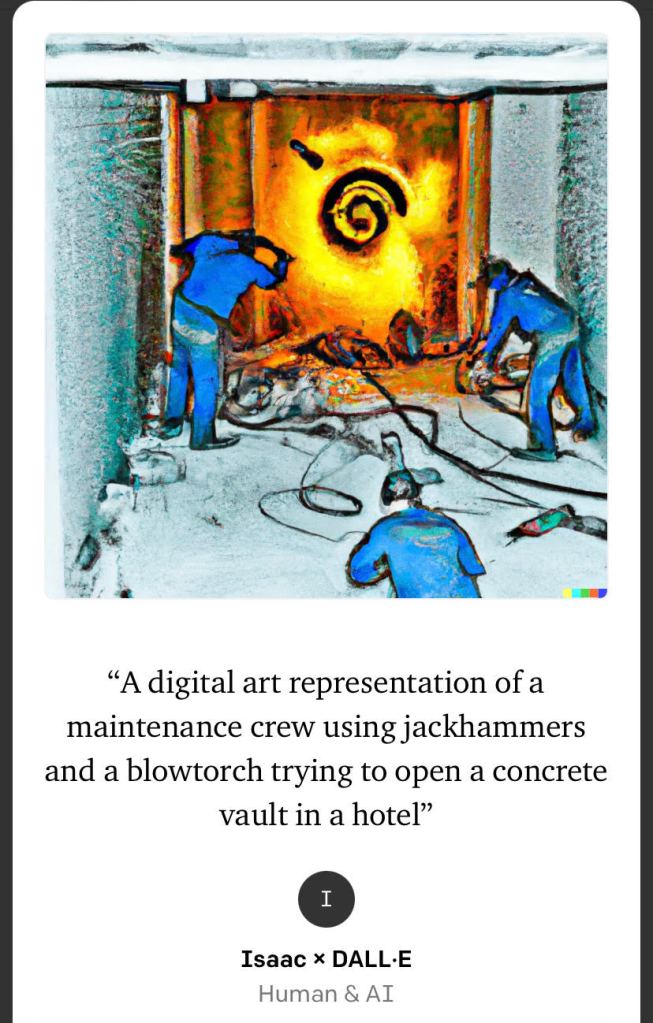
    You get to the end. The entire maintenance crew is there, working away at the vault with jackhammers and hand-chisels and a blowtorch. The concierge is there, too – so is the doorman, and the bellboy, and the valet, and the fitness trainer. Several conversations are going on at once; none of it is intelligible over the noise. 

    You gesture toward the door and ask, in your halting attempt at the local tongue, what’s going on. You get sideways glances and cold shoulders from the crew until the concierge steps in and offers to translate. You begin:

    “What are you doing to that door?”

    “We’re opening it.”

    “But what’s on the other side?”

    “Something dreadful; truly gruesome. When we breach this door, a beast that lives on the other side will be loosed.”

    “What will it do?”

    “Oh, it will be a bloodbath, sir. Guests will be slaughtered in their beds. Joists will be ripped from the walls. The hotel itself will be a mound of rubble in mere minutes. We’ll be lucky if any of us make it out alive.”

    “Why are you opening it?”

    At this, you get a blank stare. You’ve made a dreadful faux pas; announced your philistine Americanness. Still, you need some clarity. You ask again. The concierge responds a little indignantly: 

    “Sir, why aren’t you opening the door?” 

    Baffled, tired, and horribly out of your depth, you abandon diplomacy. You scream, curse, gesticulate wildly at the maintenance workers, who by now have made quite a dent in the concrete.

    The concierge, more amused than angry, wipes the spittle you’ve sprayed him with and responds:

    “Listen, sir: just above us, the 16th floor is making significant progress breaking through the 16th floor vault. They may break through to the 16th floor beast by daybreak.”

    Your face must register your bewilderment. He clarifies: 

    “How, in good conscience, sir, can we sit around, with our eldritch horror locked behind this vault, and wait for the 16th floor to release their eldritch horror and destroy this hotel as we know it?”

    II.

    My parable is a little on-the-nose. I’m sure, given the title of the series, you know what I mean by “the beast behind the door.” But if I were to extend the metaphor all the way, there’d be some updates. The guests, rather than stand mutely in doorways, would have been swarming the hall, placing bets and taking odds. Hustlers would pitch deep-pocketed guests in the hotel bar about “integrating the beast into existing workflows.” Very possibly, as some guests would surely speculate, there may not even be a beast on the other side of the concrete.

    At least with my own experience grappling with A.G.I., the broad strokes line up. Nobody knows what the beast looks like; nobody, except for the hustlers (who’ve never seen the beast) can put a positive spin on it. Everyone involved thinks it’s inevitable – and, therefore, desirable? — that the beast is freed. 

    I believe there are people out there who truly welcome A.G.I., warts and all, who don’t also want to see civilization collapse. Transhumanists would be one group. “Post-scarcity” anti-work utopians are another. Some people are seduced by the idea of a “next step in evolution,” no matter the costs; I don’t totally blame them. I find them interesting. But they’re not the class that’s accelerating the quest for A.G.I. True A.I. boosters appear to possess, if not a double consciousness, at least a decent share of cognitive dissonance.

    It’s of course possible to deeply fear an A.G.I. run amok, and still believe in the promise behind the concept. That, at any rate, is the guiding philosophy behind OpenAI (creators of DALL-E, ChatGPT, GPT-4, etc.). But we have a disparity in our stock of stories: AI promoters have built a solid canon of dystopian possibilities for A.G.I., and comparatively few visions for what A.G.I – a “new kind of mind” – could add to human civilization.

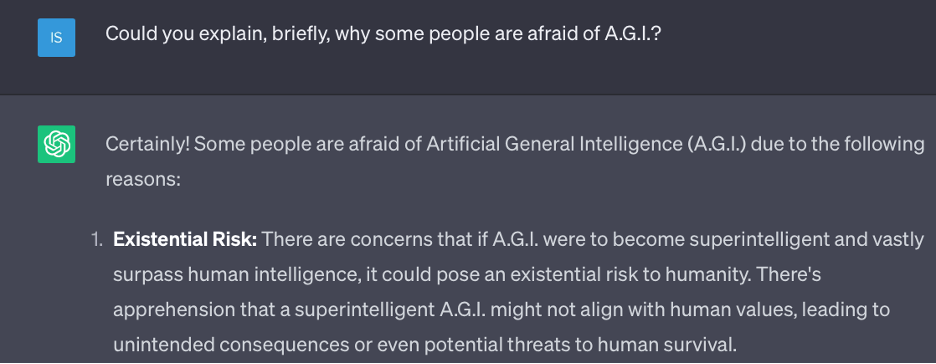
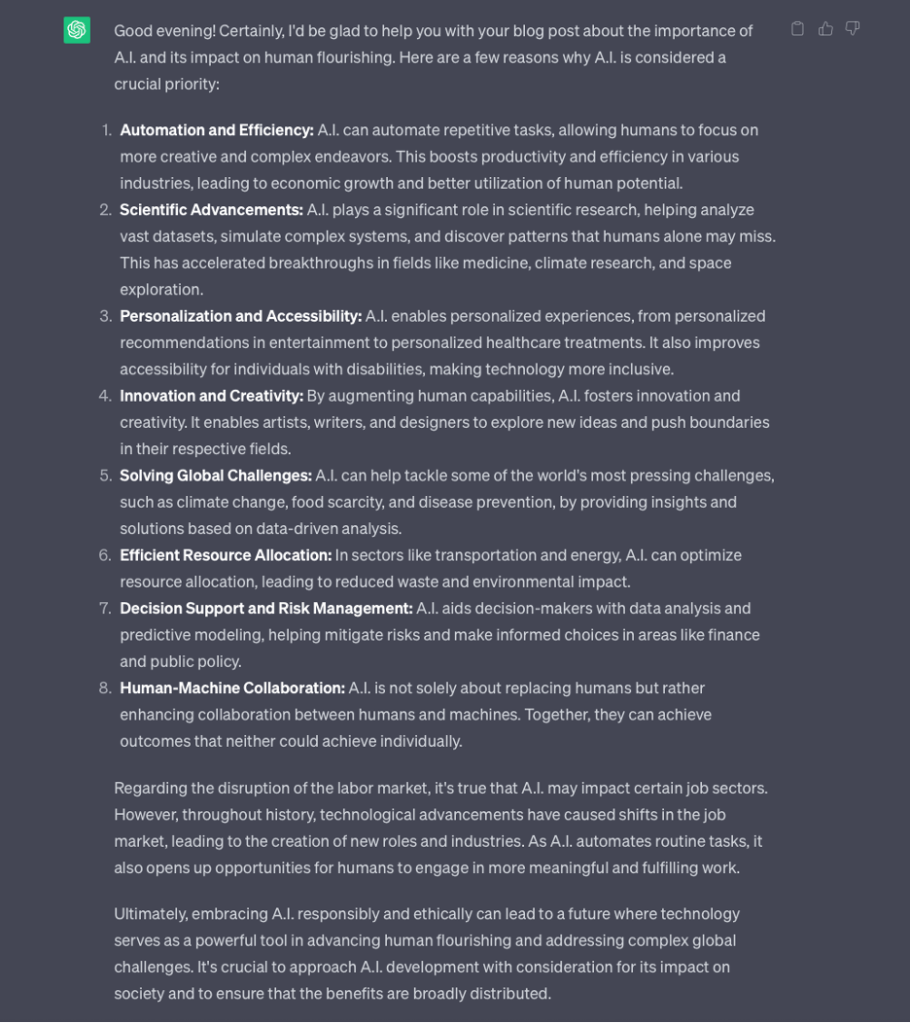
    When we do hear the benefits of A.G.I., we hear variations on “automation.” Automation and its impact on labor are perennial concerns. What would this automation look like? It’s left unsaid. I’ll let ChatGPT give the canonical answer:

    Does any of this sound well-defined? Unique? Note ChatGPT’s definition of A.G.I.: “a highly autonomous system that can perform any task a human can do.” 

    Any task a human can do is disingenuous. That’s not at all the same thing as a new order of consciousness, a new step forward for intelligence, of the sort that makes some A.I. boosters salivate (or wring their hands). A.I. taking over existing human occupations is one thing. If that were all we were talking about with A.G.I., we could cut the conversation short and say no thank you, we’d rather have full employment (or something close to it). The promise of A.G.I., if it’s going to be worth fussing over, has to be greater than this. Any task a human can do, as far as I’m concerned, is only the baseline for recognizing whether you’ve truly got A.G.I. or just a mishmash of really good programs.

    And ultimately, as I’ve heard more and more laymen claim, this cataclysmic promise of A.G.I. may just be a strategy to drum up interest. And investment. It certainly gets people talking, and writing.  

    III.

    “The man that invented the steam drill

    Thought he was mighty fine,

    But John Henry made fifteen feet;

    The steam drill only made nine.“

    Pete Seeger, “John Henry”

    John Henry beat the steam drill. He persevered over an unfeeling machine built to replace him, through his own blood and grit.

    The details of his life – even whether he was real – hardly matter. He triumphed; he became a legend. By now he’s become almost a pure archetype of human will in the face of automation.

    It also cost him his life.

    Strength – as in, brawn – is valued in the 21st century. Strength wins championships and wins places in halls of fame and record books. It’s a physical signifier of an individual’s discipline and work ethic, and often of a high level of commendable self-denial. But I don’t think any person alive would put up a modern John Henry against even the most rudimentary of modern machines. The most perfect specimen of human strength wouldn’t even be a bit player in a competition between standard-issue robotics in an average factory.  We wouldn’t even consider holding up “strength” as the defining virtue of civilization. 

    So instead we say we have other defining features. Intelligence and its cognitive relatives – creativity, empathy, understanding, wisdom, et. al. What we lack in our physical comparison to “the machines,” we more than make up for with these distinctly human intellectual traits.

    I think this is generally true. But before this year, I also never expected to have a productive conversation with a bot. Since then, I’ve asked ChatGPT – now considered lower-grade next to newer models – to write me a Socratic dialogue, and it did – in seconds. I’ve asked it to write me a screenplay full of French puns and goofy names and obscure themes, and it did, also within seconds. I’ve asked DALL-E to draw me some pictures – and, actually, it didn’t do very well with those. But my point stands.

    What sets us apart – from the vegetable/animal/mineral kingdoms, but especially from machines of our own design – has to be found in our minds. That’s our stake to specialness in the world. And now something new has arrived. It “thinks”; it “empathizes”; it “creates.” Our John Henrys are raising hammers and laughing in the face of the “new steam drills.” They’ve won a race against a machine once before. But that was a long time ago.

    “John Henry hammered in the mountain

    His hammer was striking fire.

    But he worked so hard, he broke his poor heart.

    He laid down his hammer and he died.”

    Pete Seeger, “John Henry”

  • The Sealey Challenge: the Halfway Mark

    August 17th, 2023

    Sixteen days into August, I’m eleven poetry books behind the mark for the Sealey Challenge. I’ve read only five. At this point, am I really a card-carrying participant? 

    Sure, I have a litany of excuses for those interested (I was traveling for five days; I’m a slow reader; things have been busy, etc., etc.). Still: it’s uncomfortable – like getting on a train with morning breath. Maybe nobody else notices, but the taste is unmissable. 

    31 poetry books in 31 days was always going to be a stretch. I joined partly because I wanted to test myself. What would I prioritize? How soon would despair kick in? I like to think, everything considered, I’ve done a decent job. Having even fifteen, or ten, new poetry books finished by August 31 is better than none at all. 

    Selection is harder than I expected. Books by legends and laureates are the most tempting, and likely the most rewarding, but they run long (80+ pages), and require hours of steadfast attention even for a cursory reading. By contrast, lesser-known / obscure / “minor poets” tend to run slim and read quick, to varying effect. This week – for example – I’ve put off Karl Shapiro and Robert Bly, knowing I’d never finish them in a calendar day in good conscience. And, groping around a bookshelf for the “fastest, easiest poet in sight,” I had to ask myself if this was even worth the time. The challenge seems to invite corner-cutting. 

    But Nicole Sealey isn’t playing the hall monitor; nobody’s being graded. The point is to read more poetry. With that in mind, here are some quick impressions of books I likely wouldn’t have read for a while otherwise:

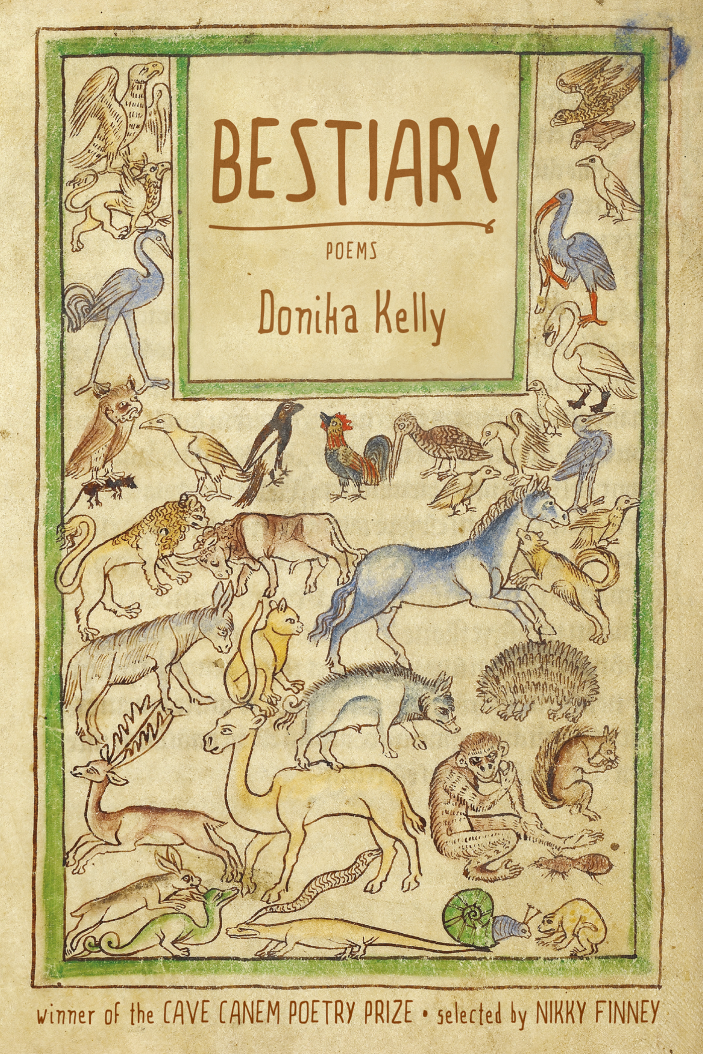
    August 1: Bestiary by Donika Kelly

    For some reason, in the 2010s, and particularly around the 2016 election, Respected PoetsTM embraced two particular fads:

    1. turning the present progressive tense into nouns (“the groaning,” “the sighing,” “the breathing,” “…in the shedding…in the molting…”), and
    2. focusing tractor-beams of attention on “the body.” Volumes upon volumes of poems centered on tongues, throats, ears, guts, etc. 

    Bestiary is sparing with the first of these, but fully embraces the second. Which is not necessarily a bad thing. 

    Its central conceit – a bestiary, naturally – actually gets washed into the background by other, far more potent themes. This is a book about trauma. Flip the book to its physical center, and you’ll find “How to be alone,” a sizeable (disturbing, and heartbreaking) suite that moves through the long fallout of a truly revolting evil. 

    For its size, this is a heavy book. 

    August 2:  Voices of Lost Souls: Writings Under Divine Destiny by Malik Santiago

    This was a mysterious purchase. I bought it from a street vendor after leafing through and seeing grainy iPhone screenshots sprinkled throughout. I could find very little evidence of its author online, and no information about the publisher. This was a bona fide independent release by an Amateur PoetTM.

    I won’t say much more except that I was surprised and charmed at turns, and put off at others. A few “Zionist / reptilian blood sucker” references too many for my taste. There were kernels of interest elsewhere: the outlines of a pseudo-Rastafarian, cosmic, diasporic worldview, shaped by a manic and contradictory poetic voice. 

    August 8: Life & Death (Poems) by Robert Creeley

    The first full book I’ve read by the Black Mountain poet. Some killer line breaks. Still processing.

    August 13: Howl and Other Poems – Allen Ginsberg

    As a college freshman, sitting down in Payson Library to read the title poem straight through, I was floored. That was the wild, expansive sort of poetry I wanted to write: poems full of angels and friends and cities, midnight journeys and heaven and hell and ecstasy. I was probably too swept up in new possibilities to take in how much despair is in this poem and the others in the collection. 

    Suffering came through more acutely this time around. My thoughts on Ginsberg as a poet have fluctuated pretty strongly in the past, but I was surprised by the freshness of his voice. As much as poets have played with and broken poetic form in the intervening decades, it’s still astounding to see Ginsberg’s inventiveness seventy years later.

    August 14: Little Pieces of Poetry: Selected Poems 1998-2019 – Garrett Buhl Robinson

    A pocket-sized collection by the “Poet in the Park,” Garrett Buhl Robinson. I didn’t have the fortune to meet him in person, but Manhattanites can find him selling his books near some major landmarks. Each poem in this volume is accompanied by some charming digital art – like with Malik Santiago, the visuals add an intriguing aesthetic flourish that likely wouldn’t have been possible even with a smaller commercial press.    

  • The Sealey Challenge: An Invitation

    July 30th, 2023

    An ambitious reading challenge launched by poet Nicole Sealey

    The Sealey Challenge, in short, is to read one book of poetry every day for the entire month of August. In this way it is both like and unlike the “Kia Challenge” from TikTok back in 2022 in that, in both cases, you are stealing something, except in one case you are breaking into a new book and stealing its wisdom, and in the other case you are doing something similar with a car, and on second thought these things are not at all the same.

    I will be attempting the Sealey Challenge this August. I invite you to join as well, especially if you don’t usually read poetry.

    The “guidelines,” such as they are, allow for either a book of poetry (50-70 pages) or a chapbook (15-30 pages) a day, and the recommendations on the semi-official site skew toward contemporary releases. I’ll be very loose with both “rules,” following the spirit rather than the letter of the law; the point of the challenge is to read a bit more poetry than usual. If an entire volume of poetry every day is unrealistic, a few poems online is better than nothing.

    Rather than plan out a list ahead of time, I’ll be reading books I have at hand that I’ve already been meaning to read. My goal is to be surprised, and to have at least a handful of hidden (or well-loved) gems to present to you by September 1st. In lieu of social media posts, I’ll be writing all my responses here. I’m always interested in what others are reading, so if you’ve picked out or read some books already, please comment below. I’ll try to check them out.

    Is this the best way to read poems? Probably not. Good poems are savored; bad and mediocre poems can be read quickly and then forgotten. The way I see it, this challenge is about exposure, both for readers (reading a huge range of poems & styles in a very compressed period), and for writers (getting audiences they may not otherwise have). As skeptical as I am about the virtues of “reading good poetry very fast,” I’m more intrigued about the possibilities. I’ve read one full book of poems this year; I need some discipline, and this challenge will be the bowling-lane-bumpers I need for the month of August.

    If you’re participating, good luck, and see you on the other side!

  • Artificial General Intelligence: A Solution in Search of a Problem?

    July 24th, 2023

    Pt. 1: Introduction

    Made with DALL-E
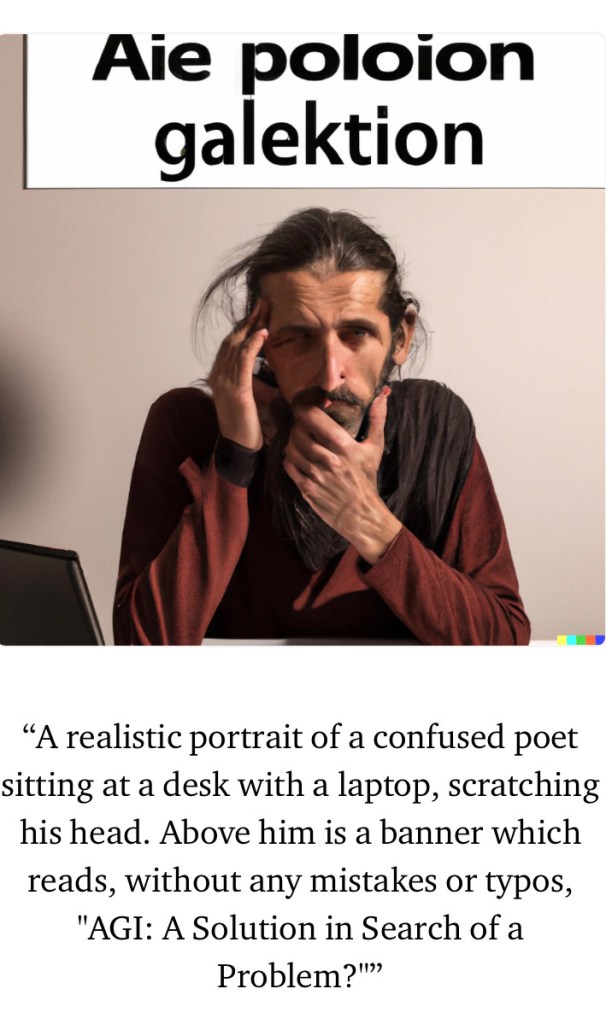
    Made with DALL-E

    “Successfully transitioning to a world with superintelligence is perhaps the most important—and hopeful, and scary—project in human history”

    – OpenAI, “Planning for AGI and beyond”

    At this point you, your coworkers, your grandparents, and your dentist probably know a good deal about artificial intelligence, and probably have some opinions about it. The ones I’ve heard tend to skew a little apocalyptic, and more than a few of them remind me of Bitcoin/NFTs’ moments in the spotlight a few years back. I truly have no new wisdom to bring to these discussions – even my recommendations of others’ views are probably out of date by now.

    And, honestly, the only stake I have in the public discourse around A.I. is in its contact with the arts. All its other applications – including the ones most often lauded by proponents and feared by doomsayers – baffle me. 

    I have nothing to add except my overpowering sense that I’m missing something profound.

    In the popular imagination at least, A.I./machine learning/large language models share a “cart before the horse,” “build it and they will come” quality that confuses and irritates me. Industries that appear to have no prior knowledge of, or use for, A.I. are flinging open their doors to welcome it into their core structures. Some A.I.-specialist services and think tanks are hawking these technologies onto sectors that, as far as I’m aware, never really asked for them and don’t know what to do with them.

    More absurdly, the very think tanks promoting the development of A.G.I. (Artificial General Intelligence) are the very ones – often the only ones – waxing hysterical about the civilization-destroying possibilities of doing so. Let’s hear from ChatGPT itself:

    (I had to cut him off somewhere.)

    If we’re going to spend the next decade being lectured by the developers of A.G.I. about the “existential risk” of inviting A.G.I. into our culture, then we need a reasonable level of clarity — or even just a better elevator pitch — on what it’s for. The justifications I’ve heard seem either nebulous, defeatist, or just plain wrong. If the technology really is as dangerous as its most enthusiastic champions claim, then it needs a better purpose before it’s fully developed.

    By the way, as far as these existential risks go: my contrarian side has grown to consider “the singularity”1 as a boogeyman used to scare tech illiterates like myself. I’m just not convinced that the recursive self-improvement of machines could lead to “runaway intelligence” the way some evangelists claim. The logic seems a little grade-school to me: if machines can learn to solve problems, they can program themselves to solve the problem of solving problems better, and so on, and a few steps later (which are never really explained), they’ll rocket exponentially toward intellectual self-perfection. “What if machines were so smart they could make themselves infinity smart?”

    Everything we know about human intelligence in the real world contradicts this – there is always an upper bound beyond which “progress” is attainable only asymptotically. And besides, when we talk about intelligence, we’re putting a name on a cluster of traits found in biological reality that can’t be multiplied as though they were a mathematical variable. We can roughly imagine a poet with an IQ of 100; there is no conceivable analogue in existence for a poet with an IQ of 10,0002. To claim that a superintelligent machine would just be smart enough to know how to breach these material barriers and keep going is fine, but it rings about as true as the mind-enhancing pill that Bradley Cooper’s hero takes in Limitless.

    People much smarter than I am, who spend careers studying machine learning, appear convinced that there is a whole lot to worry about with A.G.I. My experience is barely surface-deep; right now, I’m more than willing to take their word for it. We should be extremely careful with disruptive technology. Amen.

    One way to do this is to make the clearest possible case for A.G.I.’s benefits to a public full of laymen like me. We know very little about A.I.’s honest-to-God purpose in civilization. We hear it applauded for automating work that no one wants to do. Then we see it displace comfortable, high-skilled jobs that were doing just fine. We hear it will free up human creativity. Then we see services like Midjourney and DALL-E 2 hit the market and appear very much like they want to displace human artists. We hear things like this…

    “Mitigating the risk of extinction from AI should be a global priority alongside other societal-scale risks such as pandemics and nuclear war.”

    “Statement on AI Risk” – Center for AI Safety

    …from the only people who are actually developing A.I. at a societal scale (seriously, look at these signatories).

    This series will be written from a layman’s perspective, and with a lot of layman’s snark. I’m concerned about the future of civilization and want to know where these things fit into it – especially if, as we’re constantly reminded, they could conceivably be the very things that end us all, or at least make life substantially more annoying. I’m genuinely curious to hear the best possible justification for pursuing this technology: please comment below with any thoughts, leads, opinions, suggestions, or critiques. I’d love to hear from you.

    In the next piece, I’ll address some of the most commonly-cited cultural applications for A.I., and give my amateur’s perspective. My colleague ChatGPT has kindly given us a preview of what’s to come:

    1. “The singularity” is a hypothetical point-of-no-return at which artificial intelligence becomes proficient enough to be able to improve itself exponentially, leading to a superhuman or even God-like level of intelligence. Needless to say, I’m extremely skeptical that such a thing is physically possible. I could be wrong. ↩︎
    2. The 10,000 figure is lifted, and paraphrased, from a Sam Harris podcast episode (Making Sense “Episode 8: Ask Me Anything 1”). Harris is somebody who worries a lot about “recursive self-improvement” in intelligent machines, predicting they “could make tens of thousands of years of human intellectual progress in days, or even minutes.” Again, it depends on how you class the intelligence involved, but I’m still extremely skeptical that this could be physically possible. The dangers of A.I., in my view, are far more near-term than these science fiction-esque hypotheses. ↩︎
  • Discoveries Log #1

    July 22nd, 2023

    Week of July 16, 2023

    I don’t need to remind you how remarkable a thing the internet is. These are just some remarkable things I’ve come across in the last week, either on purpose or through algorithm-wizardry, while procrastinating.

    A thorough explanation of lab-grown meat from The Counter (from 2021)

    If you’re like me and see lab-grown meat as something game-changing (even salvific), or if you find the idea strange/repulsive, this longer article from Joe Fassler is worth a read. Fassler explains the potentially insurmountable challenges of scaling up cultured meat to something more than a luxury item, and takes aim at the (apparently) premature optimism of the tech investors driving it forward.

    Is it a strong enough case to dissuade investment in something that might be a dead end? I’m not entirely convinced, but that’s largely because I so badly want there to be a way for this to work.

    Joe Fassler, “Lab-grown meat is supposed to be inevitable. The science tells a different story.” The Counter, September 2, 2021.

    BobbyBroccoli’s YouTube Channel

    I’m a humanities guy through-and-through, and I get most of my STEM knowledge third- or fourth-hand through the work of science popularizers and video essayists like BobbyBroccoli.

    I found BobbyBroccoli’s channel a summer ago, and caught up with it again recently. His multi-hour exposés on frauds, failures, and missed opportunities in the sciences are enthralling, in part because they hit the sweet spots that draw “humanities people” to science stories: the mystique of “genius,” the concept of “progress,” etc. I recommend starting with the story of Jan Hendrik Schön, “The man who almost faked his way to a Nobel Prize.”

    Austin City Limits (and Pavement, and Spoon, and The War on Drugs, and…)

    Two years back I realized that if I never put in the effort to actually listen to the albums I always said I would “get to,” then, simply, I would never actually hear them. This self-intervention was a small miracle: I’ve heard more music, and more new-to-me music, in the last 800 or so days than I have since the magical taste-making days of high school.

    While reading/writing/lounging with my dogs this week, I had PBS’s “Austin City Limits” running in the background. I’d meant it as background music (a “necessary evil” method of listening), but was distracted over and over by the performers’ energy. These were artists I’d only slightly known, and granted, I’m not a concert-goer to begin with— but seeing and hearing them with fresh ears revived my confidence in the vitality, durability, and reach of the sort of punk-adjacent, lyric-forward rock music I was drawn to back in my embarrassing days as a high school lyricist. I picked up my guitar this week for the first time in a long time.

    Local Interest: A Revolutionary War-Era home (temporarily) saved from demolition

    This might merit a longer post (I’m a little too caught up in the drama involved). But, in brief: an Eastchester, New York home dating to the 1700s, known locally as “The Ward House,” passed a major hurdle in efforts to preserve it from demolition. It’s the first of (hopefully) many victories to come for one of Westchester County’s oldest existing structures, and the site of wartime bloodshed. More on this soon!

    Some links for out-of-towners or history geeks:
    Jonathan Gordon, “Tuckahoe historic preservation board rules against Ward House developer.” News 12 Westchester, July 20, 2023.
    “Stephen Ward: A Local Revolutionary Leader who guided the town’s transition from colonial times to the early republic”, The National Park Service.
    “Ward House Timeline,” Friends of the Ward House.

1 2
Next Page→

Blog at WordPress.com.


Loading Comments...
 

    • Subscribe Subscribed
      • The Procrastinating Poet
      • Already have a WordPress.com account? Log in now.
      • The Procrastinating Poet
      • Subscribe Subscribed
      • Sign up
      • Log in
      • Report this content
      • View site in Reader
      • Manage subscriptions
      • Collapse this bar