Skip to content
    • About The Procrastinating Poet
    • Articles and Other Writings
    • Contact Form (for any reason)
    • Posts (Archive)
    • Reading Log

The Procrastinating Poet

  • The Sealey Challenge: the Halfway Mark

    August 17th, 2023

    Sixteen days into August, I’m eleven poetry books behind the mark for the Sealey Challenge. I’ve read only five. At this point, am I really a card-carrying participant? 

    Sure, I have a litany of excuses for those interested (I was traveling for five days; I’m a slow reader; things have been busy, etc., etc.). Still: it’s uncomfortable – like getting on a train with morning breath. Maybe nobody else notices, but the taste is unmissable. 

    31 poetry books in 31 days was always going to be a stretch. I joined partly because I wanted to test myself. What would I prioritize? How soon would despair kick in? I like to think, everything considered, I’ve done a decent job. Having even fifteen, or ten, new poetry books finished by August 31 is better than none at all. 

    Selection is harder than I expected. Books by legends and laureates are the most tempting, and likely the most rewarding, but they run long (80+ pages), and require hours of steadfast attention even for a cursory reading. By contrast, lesser-known / obscure / “minor poets” tend to run slim and read quick, to varying effect. This week – for example – I’ve put off Karl Shapiro and Robert Bly, knowing I’d never finish them in a calendar day in good conscience. And, groping around a bookshelf for the “fastest, easiest poet in sight,” I had to ask myself if this was even worth the time. The challenge seems to invite corner-cutting. 

    But Nicole Sealey isn’t playing the hall monitor; nobody’s being graded. The point is to read more poetry. With that in mind, here are some quick impressions of books I likely wouldn’t have read for a while otherwise:

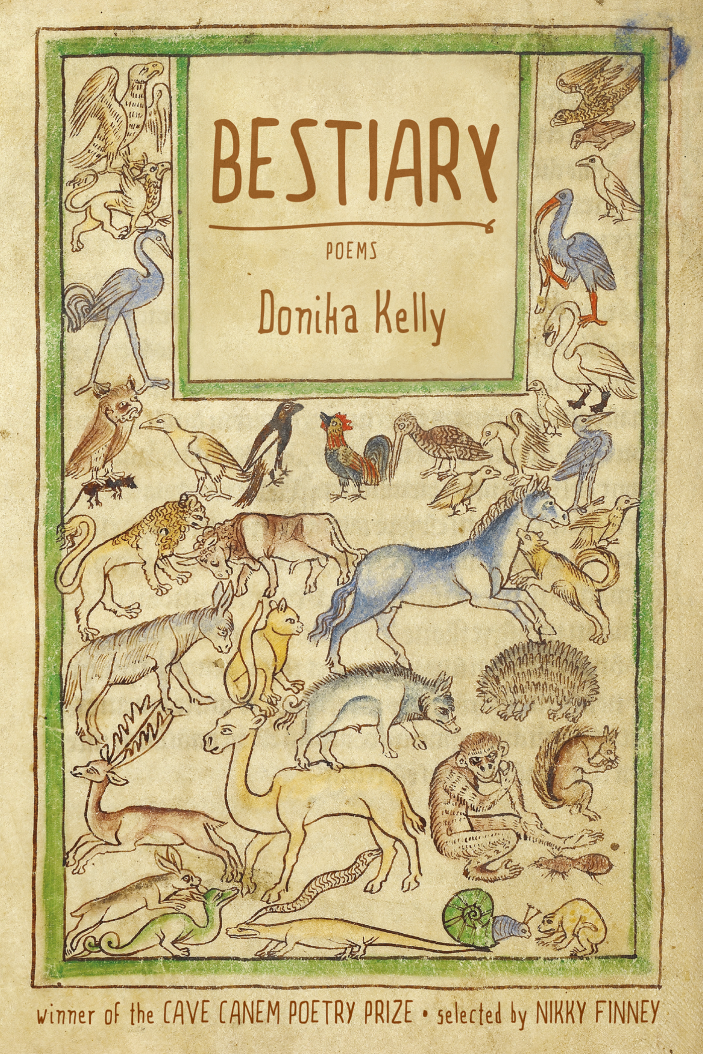
    August 1: Bestiary by Donika Kelly
    For some reason, in the 2010s, and particularly around the 2016 election, Respected PoetsTM embraced two particular fads:

    1. turning the present progressive tense into nouns (“the groaning,” “the sighing,” “the breathing,” “…in the shedding…in the molting…”), and
    2. focusing tractor-beams of attention on “the body.” Volumes upon volumes of poems centered on tongues, throats, ears, guts, etc. 

    Bestiary is sparing with the first of these, but fully embraces the second. Which is not necessarily a bad thing. 

    Its central conceit – a bestiary, naturally – actually gets washed into the background by other, far more potent themes. This is a book about trauma. Flip the book to its physical center, and you’ll find “How to be alone,” a sizeable (disturbing, and heartbreaking) suite that moves through the long fallout of a truly revolting evil. 

    For its size, this is a heavy book. 

    August 2:  Voices of Lost Souls: Writings Under Divine Destiny by Malik Santiago

    This was a mysterious purchase. I bought it from a street vendor after leafing through and seeing grainy iPhone screenshots sprinkled throughout. I could find very little evidence of its author online, and no information about the publisher. This was a bona fide independent release by an Amateur PoetTM.

    I won’t say much more except that I was surprised and charmed at turns, and put off at others. A few “Zionist / reptilian blood sucker” references too many for my taste. There were kernels of interest elsewhere: the outlines of a pseudo-Rastafarian, cosmic, diasporic worldview, shaped by a manic and contradictory poetic voice. 

    August 8: Life & Death (Poems) by Robert Creeley

    The first full book I’ve read by the Black Mountain poet. Some killer line breaks. Still processing.

    August 13: Howl and Other Poems – Allen Ginsberg

    As a college freshman, sitting down in Payson Library to read the title poem straight through, I was floored. That was the wild, expansive sort of poetry I wanted to write: poems full of angels and friends and cities, midnight journeys and heaven and hell and ecstasy. I was probably too swept up in new possibilities to take in how much despair is in this poem and the others in the collection. 

    Suffering came through more acutely this time around. My thoughts on Ginsberg as a poet have fluctuated pretty strongly in the past, but I was surprised by the freshness of his voice. As much as poets have played with and broken poetic form in the intervening decades, it’s still astounding to see Ginsberg’s inventiveness seventy years later.

    August 14: Little Pieces of Poetry: Selected Poems 1998-2019 – Garrett Buhl Robinson

    A pocket-sized collection by the “Poet in the Park,” Garrett Buhl Robinson. I didn’t have the fortune to meet him in person, but Manhattanites can find him selling his books near some major landmarks. Each poem in this volume is accompanied by some charming digital art – like with Malik Santiago, the visuals add an intriguing aesthetic flourish that likely wouldn’t have been possible even with a smaller commercial press.    
  • The Sealey Challenge: An Invitation

    July 30th, 2023

    An ambitious reading challenge launched by poet Nicole Sealey

    The Sealey Challenge, in short, is to read one book of poetry every day for the entire month of August. In this way it is both like and unlike the “Kia Challenge” from TikTok back in 2022 in that, in both cases, you are stealing something, except in one case you are breaking into a new book and stealing its wisdom, and in the other case you are doing something similar with a car, and on second thought these things are not at all the same.

    I will be attempting the Sealey Challenge this August. I invite you to join as well, especially if you don’t usually read poetry.

    The “guidelines,” such as they are, allow for either a book of poetry (50-70 pages) or a chapbook (15-30 pages) a day, and the recommendations on the semi-official site skew toward contemporary releases. I’ll be very loose with both “rules,” following the spirit rather than the letter of the law; the point of the challenge is to read a bit more poetry than usual. If an entire volume of poetry every day is unrealistic, a few poems online is better than nothing.

    Rather than plan out a list ahead of time, I’ll be reading books I have at hand that I’ve already been meaning to read. My goal is to be surprised, and to have at least a handful of hidden (or well-loved) gems to present to you by September 1st. In lieu of social media posts, I’ll be writing all my responses here. I’m always interested in what others are reading, so if you’ve picked out or read some books already, please comment below. I’ll try to check them out.

    Is this the best way to read poems? Probably not. Good poems are savored; bad and mediocre poems can be read quickly and then forgotten. The way I see it, this challenge is about exposure, both for readers (reading a huge range of poems & styles in a very compressed period), and for writers (getting audiences they may not otherwise have). As skeptical as I am about the virtues of “reading good poetry very fast,” I’m more intrigued about the possibilities. I’ve read one full book of poems this year; I need some discipline, and this challenge will be the bowling-lane-bumpers I need for the month of August.

    If you’re participating, good luck, and see you on the other side!

  • Artificial General Intelligence: A Solution in Search of a Problem?

    July 24th, 2023

    Pt. 1: Introduction

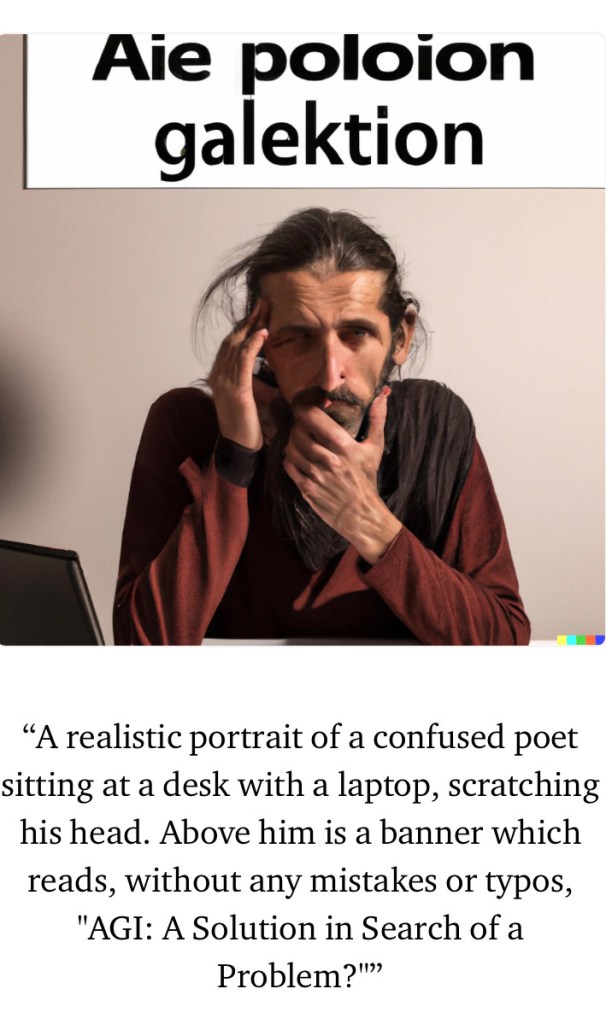
    Made with DALL-E
    Made with DALL-E

    “Successfully transitioning to a world with superintelligence is perhaps the most important—and hopeful, and scary—project in human history”

    – OpenAI, “Planning for AGI and beyond”

    At this point you, your coworkers, your grandparents, and your dentist probably know a good deal about artificial intelligence, and probably have some opinions about it. The ones I’ve heard tend to skew a little apocalyptic, and more than a few of them remind me of Bitcoin/NFTs’ moments in the spotlight a few years back. I truly have no new wisdom to bring to these discussions – even my recommendations of others’ views are probably out of date by now.

    And, honestly, the only stake I have in the public discourse around A.I. is in its contact with the arts. All its other applications – including the ones most often lauded by proponents and feared by doomsayers – baffle me. 

    I have nothing to add except my overpowering sense that I’m missing something profound.

    In the popular imagination at least, A.I./machine learning/large language models share a “cart before the horse,” “build it and they will come” quality that confuses and irritates me. Industries that appear to have no prior knowledge of, or use for, A.I. are flinging open their doors to welcome it into their core structures. Some A.I.-specialist services and think tanks are hawking these technologies onto sectors that, as far as I’m aware, never really asked for them and don’t know what to do with them.

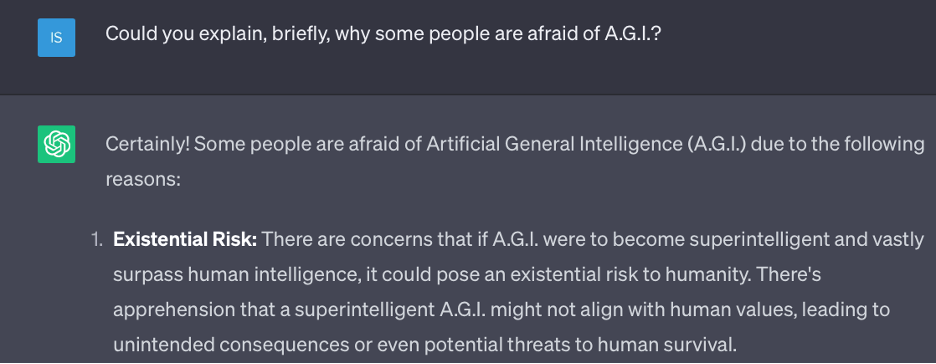
    More absurdly, the very think tanks promoting the development of A.G.I. (Artificial General Intelligence) are the very ones – often the only ones – waxing hysterical about the civilization-destroying possibilities of doing so. Let’s hear from ChatGPT itself:

    (I had to cut him off somewhere.)

    If we’re going to spend the next decade being lectured by the developers of A.G.I. about the “existential risk” of inviting A.G.I. into our culture, then we need a reasonable level of clarity — or even just a better elevator pitch — on what it’s for. The justifications I’ve heard seem either nebulous, defeatist, or just plain wrong. If the technology really is as dangerous as its most enthusiastic champions claim, then it needs a better purpose before it’s fully developed.

    By the way, as far as these existential risks go: my contrarian side has grown to consider “the singularity”1 as a boogeyman used to scare tech illiterates like myself. I’m just not convinced that the recursive self-improvement of machines could lead to “runaway intelligence” the way some evangelists claim. The logic seems a little grade-school to me: if machines can learn to solve problems, they can program themselves to solve the problem of solving problems better, and so on, and a few steps later (which are never really explained), they’ll rocket exponentially toward intellectual self-perfection. “What if machines were so smart they could make themselves infinity smart?”

    Everything we know about human intelligence in the real world contradicts this – there is always an upper bound beyond which “progress” is attainable only asymptotically. And besides, when we talk about intelligence, we’re putting a name on a cluster of traits found in biological reality that can’t be multiplied as though they were a mathematical variable. We can roughly imagine a poet with an IQ of 100; there is no conceivable analogue in existence for a poet with an IQ of 10,0002. To claim that a superintelligent machine would just be smart enough to know how to breach these material barriers and keep going is fine, but it rings about as true as the mind-enhancing pill that Bradley Cooper’s hero takes in Limitless.

    People much smarter than I am, who spend careers studying machine learning, appear convinced that there is a whole lot to worry about with A.G.I. My experience is barely surface-deep; right now, I’m more than willing to take their word for it. We should be extremely careful with disruptive technology. Amen.

    One way to do this is to make the clearest possible case for A.G.I.’s benefits to a public full of laymen like me. We know very little about A.I.’s honest-to-God purpose in civilization. We hear it applauded for automating work that no one wants to do. Then we see it displace comfortable, high-skilled jobs that were doing just fine. We hear it will free up human creativity. Then we see services like Midjourney and DALL-E 2 hit the market and appear very much like they want to displace human artists. We hear things like this…

    “Mitigating the risk of extinction from AI should be a global priority alongside other societal-scale risks such as pandemics and nuclear war.”

    “Statement on AI Risk” – Center for AI Safety

    …from the only people who are actually developing A.I. at a societal scale (seriously, look at these signatories).

    This series will be written from a layman’s perspective, and with a lot of layman’s snark. I’m concerned about the future of civilization and want to know where these things fit into it – especially if, as we’re constantly reminded, they could conceivably be the very things that end us all, or at least make life substantially more annoying. I’m genuinely curious to hear the best possible justification for pursuing this technology: please comment below with any thoughts, leads, opinions, suggestions, or critiques. I’d love to hear from you.

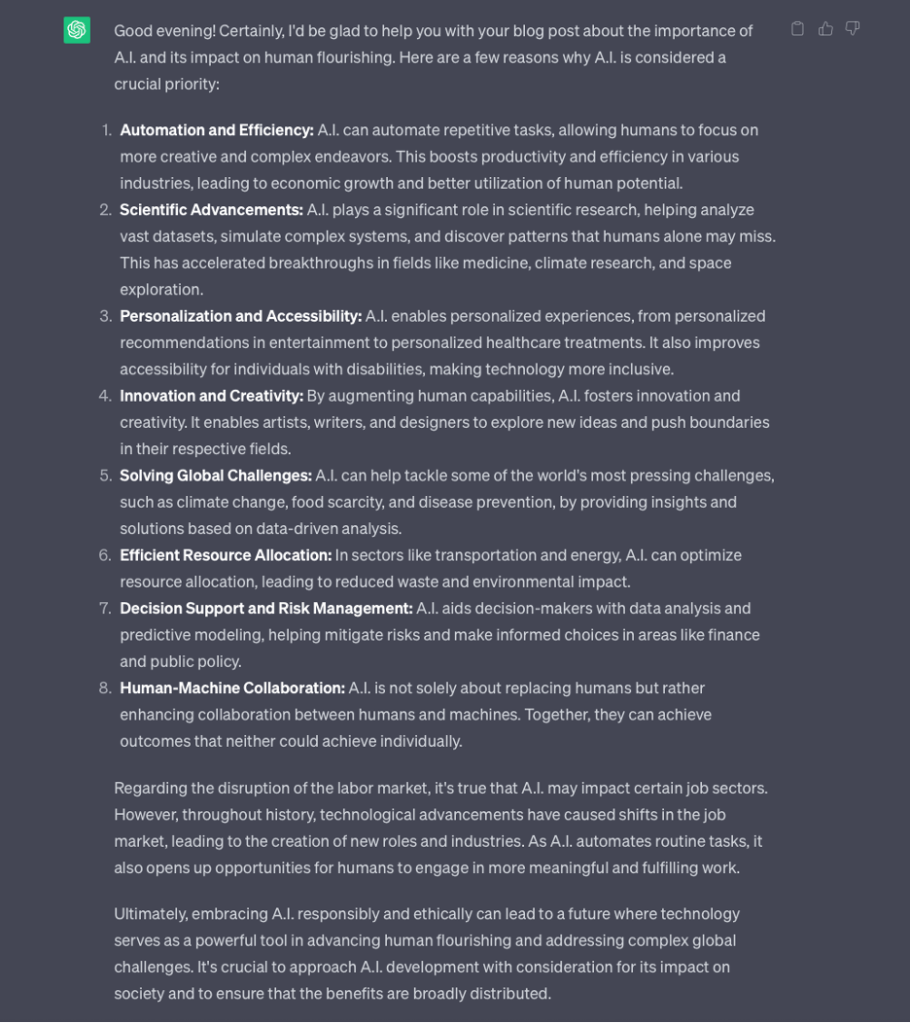
    In the next piece, I’ll address some of the most commonly-cited cultural applications for A.I., and give my amateur’s perspective. My colleague ChatGPT has kindly given us a preview of what’s to come:

    1. “The singularity” is a hypothetical point-of-no-return at which artificial intelligence becomes proficient enough to be able to improve itself exponentially, leading to a superhuman or even God-like level of intelligence. Needless to say, I’m extremely skeptical that such a thing is physically possible. I could be wrong. ↩︎
    2. The 10,000 figure is lifted, and paraphrased, from a Sam Harris podcast episode (Making Sense “Episode 8: Ask Me Anything 1”). Harris is somebody who worries a lot about “recursive self-improvement” in intelligent machines, predicting they “could make tens of thousands of years of human intellectual progress in days, or even minutes.” Again, it depends on how you class the intelligence involved, but I’m still extremely skeptical that this could be physically possible. The dangers of A.I., in my view, are far more near-term than these science fiction-esque hypotheses. ↩︎
  • Discoveries Log #1

    July 22nd, 2023

    Week of July 16, 2023

    I don’t need to remind you how remarkable a thing the internet is. These are just some remarkable things I’ve come across in the last week, either on purpose or through algorithm-wizardry, while procrastinating.

    A thorough explanation of lab-grown meat from The Counter (from 2021)

    If you’re like me and see lab-grown meat as something game-changing (even salvific), or if you find the idea strange/repulsive, this longer article from Joe Fassler is worth a read. Fassler explains the potentially insurmountable challenges of scaling up cultured meat to something more than a luxury item, and takes aim at the (apparently) premature optimism of the tech investors driving it forward.

    Is it a strong enough case to dissuade investment in something that might be a dead end? I’m not entirely convinced, but that’s largely because I so badly want there to be a way for this to work.

    Joe Fassler, “Lab-grown meat is supposed to be inevitable. The science tells a different story.” The Counter, September 2, 2021.

    BobbyBroccoli’s YouTube Channel

    I’m a humanities guy through-and-through, and I get most of my STEM knowledge third- or fourth-hand through the work of science popularizers and video essayists like BobbyBroccoli.

    I found BobbyBroccoli’s channel a summer ago, and caught up with it again recently. His multi-hour exposés on frauds, failures, and missed opportunities in the sciences are enthralling, in part because they hit the sweet spots that draw “humanities people” to science stories: the mystique of “genius,” the concept of “progress,” etc. I recommend starting with the story of Jan Hendrik Schön, “The man who almost faked his way to a Nobel Prize.”

    Austin City Limits (and Pavement, and Spoon, and The War on Drugs, and…)

    Two years back I realized that if I never put in the effort to actually listen to the albums I always said I would “get to,” then, simply, I would never actually hear them. This self-intervention was a small miracle: I’ve heard more music, and more new-to-me music, in the last 800 or so days than I have since the magical taste-making days of high school.

    While reading/writing/lounging with my dogs this week, I had PBS’s “Austin City Limits” running in the background. I’d meant it as background music (a “necessary evil” method of listening), but was distracted over and over by the performers’ energy. These were artists I’d only slightly known, and granted, I’m not a concert-goer to begin with— but seeing and hearing them with fresh ears revived my confidence in the vitality, durability, and reach of the sort of punk-adjacent, lyric-forward rock music I was drawn to back in my embarrassing days as a high school lyricist. I picked up my guitar this week for the first time in a long time.

    Local Interest: A Revolutionary War-Era home (temporarily) saved from demolition

    This might merit a longer post (I’m a little too caught up in the drama involved). But, in brief: an Eastchester, New York home dating to the 1700s, known locally as “The Ward House,” passed a major hurdle in efforts to preserve it from demolition. It’s the first of (hopefully) many victories to come for one of Westchester County’s oldest existing structures, and the site of wartime bloodshed. More on this soon!

    Some links for out-of-towners or history geeks:
    Jonathan Gordon, “Tuckahoe historic preservation board rules against Ward House developer.” News 12 Westchester, July 20, 2023.
    “Stephen Ward: A Local Revolutionary Leader who guided the town’s transition from colonial times to the early republic”, The National Park Service.
    “Ward House Timeline,” Friends of the Ward House.

  • Welcome to The Procrastinating Poet!

    July 3rd, 2023

    I’m glad you’re here.

    Where are you, exactly? Literally speaking, somewhere in the interstitial space made by a WordPress data center, some screens, a few ambitious radio waves, etc. But what sort of interstitial space? What’s with the “procrastinating poet” and what is this place for?

    In short: this is the home for a poet’s writings about everything except poetry. (And maybe some poetry too.)

    When I was in college, and should have been doing classwork, I read a quote that lingered for years afterward. It wasn’t from a poem/novel/film/wizened professor. It was (as these sorts of things go) in a quickly-skimmed article in a book of essays about a poet, that I’d grabbed for no particular reason from a library shelf, and returned an hour later; providence has a way of working out.

    I was floored by its genius. I wrestled with the quote on and off for weeks and then months. Its ethos described, I thought, exactly the problems I was having as a writer. And when starting this blog (after further years of procrastination), I knew I had to track it down. It would illuminate everything.

    An hour or so after dealing with the Byzantine laws of alumni library access, vainly typing in keyword after keyword, I found it:

    “Wordsworth once informed an American visitor that although he was known to the world as a poet, ‘he had given twelve hours thought to the conditions of society, for one to poetry.’”

    Joel Pace, “Wordsworth and America: reception and reform”

    Well: needless to say, it wasn’t the transcendental insight I thought I’d remembered. (And, to clarify, I am not the Wordsworth in this equation) But it’s close enough.

    This blog will be, in short, built on the same 12:1 ratio of “non-poetry to poetry” that Wordsworth describes, and which I think is a fair summary of how this poet experiences the world. It will feature things that capture my attention when I “ought” to be writing, and that never make their way into my poetry: space travel; movies; history; nature; video games; dogs; music; small doses of politics & philosophy; things I enjoy and things I loathe; any flavor or variation of”food for thought.”

    An audience is a writer’s lifeline. Thank you for being a part of this poet’s audience, in whatever way you choose. If you’re the commenting type, please feel free to comment. If not, I hope this site provides something in the way of “good procrastination” — maybe the kind that leads to new discoveries, interests, or ideas (the stuff, in some sense, of poetry).

←Previous Page
1 2

Blog at WordPress.com.

Loading Comments...
    • Subscribe Subscribed
      • The Procrastinating Poet
      • Already have a WordPress.com account? Log in now.
      • The Procrastinating Poet
      • Subscribe Subscribed
      • Sign up
      • Log in
      • Report this content
      • View site in Reader
      • Manage subscriptions
      • Collapse this bar