A personal take on a craft that’s (almost) lost its spark
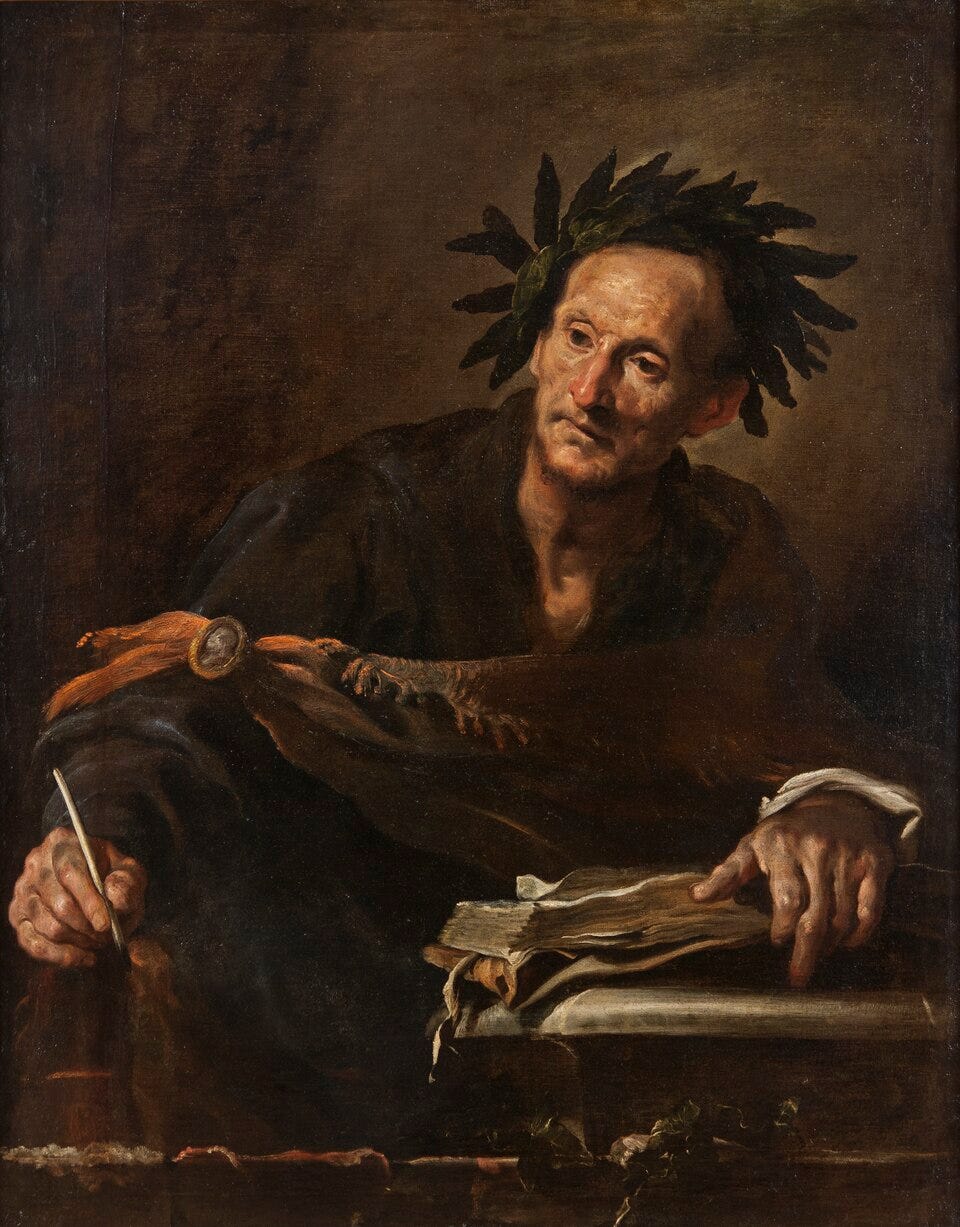
I loved poetry, and I think I still love her. Please don’t misunderstand. There will be no death knells to poetry here, à la Joseph Epstein. I have no interest (right now) in telling the many, many ways poetry has had a poor showing in the world outside its own ghettos. I love the schadenfreude of a good literary hatchet job as much as anybody; I love reading William Logan put contemporary poets (even beloved ones) into literary full-Nelsons. I was thrilled by Tanner Stening’s recent takedown of poetic pretensions in The Metropolitan Review. It’s fun and cathartic to take the piñata treatment to contemporary poetry. (I can say that; some of my best friends are poets) But this piece is neither a manifesto nor a declamation on the poetry scene at large. This is what I think they call in couple’s therapy, “emotional ventilation.”
The thing is: poetry and I have cooled on one another. And though I know we’ll be entangled for life, I’ve realized, after countless low-grade disappointments and category errors, that there’s no livable path forward between us unless we put these grievances in the open.
I write and read vast amounts of poetry for pleasure, and I teach and edit vast amounts of poetry as part of my work. I spent four years studying poetry and then two more years studying it far, far more intensely. The MFA is a curious kind of degree, compared with other tracks for humanities grads. You spend enormous amounts of your coursework not necessarily probing the classics (although there’s plenty of that, too), but dissecting works in progress—yours and others’. Dissection really is the word for it: you put the poor printouts flat on the table and scribble and pluck them into seventeen different kinds of submission, and you end up with the guts of the thing spread out across the room and everyone upset. You see every possible angle of every possible kind of poetic expression at every stage, many of them (especially yours) bloody and awful.
I say this not to establish my poetry bona fides—I mean, after all, my one published work to date, written at the ripe age of 11, shockingly listed as “Out of Print” on Amazon, but still (I think) paying three dollars in royalties per copy sold, and now with its own Goodreads page filled with exclamatory AI-bot-generated reviews, was a work of supernatural horror fiction—but to show that I care.
From the beginning, then, briefly: I was enchanted with literature as a very young child, and a little while later I became enchanted with capital-a “Art.” Finally there was a word that yoked and unified all the things I found most precious in my free time: writing, drawing, painting, video game design, music (Rock and Hip-Hop and orchestral and everything I could find). Everything. “Art” was also ancient and, uniquely among youthful interests, universally respectable. It was popular and it was elite. You never had to feel silly or embarrassed about “Art”—artworks, yes, sometimes, but not “Art.” “Art” had its defenders in all times and corners of human experience, and to be involved in it, as an appreciator or as a creator, felt like a sacred calling. I was in middle school, and the following years would refine this perception into a near-religious devotion.
Poetry wasn’t primus inter pares among the arts from the beginning. It never had the pathos of great films or the expansiveness of thrilling novels—but it was portable, and it was flexible, and it sat comfortably at the crossroads of other art forms I deeply loved. It was both a cousin to songwriting and a silent, moody child of the print world. Unlike with, say, video games, or comic books, or landscape painting, a single artist working through poetry could switch registers instantly. You could knock out a poem about the horrors of World War I during lunch after World History, and then you could write sardonic, braggadocious odes during Spanish (I may be speaking from experience). And, it seemed from my high school research, everybody in the world of “Art” wrote poems. Novelists wrote them; Picasso wrote them; rock stars wrote them. It was the most accessible and economical of all the arts.
I had no facility with drawing, and only a little with music, so when it came time to specialize in the years to come, poetry was my first choice. It stayed that way for the next seven years.
But familiarity breeds contempt, or if not contempt, passive aggressiveness. The only way out is through, so here, I suppose, are all the reasons I can think of that poetry has “lost its shine.” I will not call out any poets or presses by name. In the spirit of a good therapy session, I’ve simply prepared a rambling and petulant list:
Most poetry (like most writing) is bad. Most published poetry is— fine.
This means, in other words, that for the vast, vast, vast majority of my time spent reading new poetry, the dominant sensation is neutrality. Occasionally outrage, sometimes meditative gloom, but rarely anything that redeems the time. It feels mercenary to say so. I wouldn’t even say so in the first place, except for the realization that poetry is the only genre of literature that seems to produce this sensation of tastelessness for me. Prose almost always thrills, even when it infuriates. Plays are structurally incapable of being dull. But an hour spent reading contemporary poetry, even as somebody with my poetic sea legs under me, is almost always just fine.
The thing is, time is so short. I have decades ahead of me, if I’m lucky. But there is so much to read, and even in these early acts of adult life, I’m having a harder and harder time justifying reading hours which I can almost guarantee in advance are going to be, simply, fine.
“Nobody cares about poetry”
In the spirit of honesty in this relationship, I will say that this never used to bother me. I said at the beginning of this relationship that it would never bother me. I went in knowing that contemporary poetry was one long extra-innings game of insider baseball after another. “Nobody reads” poetry, “nobody cares” about poetry, “nobody discusses” it, it’s “a cultural fossil,” it’s “elitist,” it’s “backward”—I didn’t care. Poetry was precious because it wormed out from under the lids of neat containers. It was its own thing. It was, even, sort of, “exclusive.” It had a solid, devoted following of aesthetes, and it was beautiful, and that was enough.
For a while. But it became exhausting, too. The overwhelming majority of the global population does not read for pleasure, and an infinitesimal fraction of that readership reads new poetry. And that fraction is overwhelmingly, maybe exclusively, made of other poets or aspiring poets. And the overwhelming majority of those poet-readers read new poetry in order to support their friends, or to keep up with the culture, or to check if their own work meets a certain journal’s standards. I would venture that very little of that reading is based on pure, disinterested pleasure. By the sheer volume of MFA grads in circulation, most poets do not know most other poets and have no real likelihood of reaching one another unless they shared a program with them. Writing and reading poetry is a spiritually purifying exercise, but it is, by definition, siloed labor.
There are, roughly, 10,000 new poetry releases a year in the United States, as well as over a thousand “little magazines” and a solid few hundred small presses putting out new work. The average new poetry volume, between 70 to 100 pages in length, sells barely enough copies to cover printing costs. A good percent of small presses are nonprofits, and many rely on state or public funding. A venal, cruel way to put this might be: Poets are being subsidized by a public that has absolutely no interest in what they do. That’s an exaggeration, but only partly. I have worked with and among many of these institutions and will continue to do so. I know and love this ecosystem. But even those in the ecosystem know that their cultural footprint is basically imperceptible. And even though every poet I’ve ever known, including myself, has daydreamed of starting up a new journal or small press, one that will really innovate and expand the culture, the reality is that there are already too many journals and too many presses to matter. Attention and resources are splintered across thousands of mostly identical publications. If poets want to reach the “real world”—which is not everyone’s goal—then consolidation would be the surer strategy.
There are defenses for every single part of why the poetry world works the way it does. I don’t need to make them, I don’t need to hear them again, because I live in that world and I am committed to its survival. All I’m saying is this: it does become really, really dispiriting to work toward something, and promote something, that “real people” do not, and will never, read. There is a sturdy wall between poets and “real people.” And outside of really, truly exceptional work, it’s impossible to imagine scaling over this wall to let real people in. There’s a reason that most poetry recommendations tend to be works that are older and more time-tested. Even on the best day, I can’t imagine slipping an ordinary volume of contemporary verse to a grocer, or a nurse, or a suburban mom, or a fry cook dad, or a mechanic, or a Wall Street quant, or an evangelical pastor, or a DC staffer, or a dreamy-eyed high school kid. There’s not even enough residual confidence among most of us poets to try. Maybe it’s only me. Maybe I’m a yellow-bellied coward. I simply fear that most new poetry is not going to do anything for most people.
Songwriting can do everything that poetry claims to do, and does it better, and reaches more people, and has done more for the human race than poetry has done since the 1950s.
I can’t prove the claim above in any scientific sense. It’s a category error to compare genres like this. But I challenge other poets to dispute it. What does your gut tell you? Does it actually seem wrong? The only thing we poets can say in response is: It’s not a competition. Sure. I agree.
Still: take any year after 1950 as your starting point and measure the collected outputs of popular music and mainstream poetry from that point onward until the present and match them together. Which body of work is better in all the ways that matter for poetic expression? Which body of work straddles the delicate balance of public and private experience? Which has energized more fellow artists and seeded the culture with a renewed attention to language and the hidden musicality of words? If you had to make the case that “Art” can really, truly change somebody’s life, can resurrect them, can pull them from their swirling Gehennas of self-loathing and inwardness and give them a small, glimmering chance to experience the depth of human life in a way that felt real, in a way that reverberated from their core to every extremity of their body—which would you choose as your champion?
I don’t think it’s an unfair question. The poetry vs. songwriting question is a family affair. In my poetry classes, I always love showing students the family tree of poetry’s deep history and the many splintering branches that emerged from a distant past where songwriting and poetry writing were essentially identical crafts. The very term “lyric poetry” (that is, poetry written to be accompanied by a lyre) betrays this history. Hip-Hop lyrics and Rock lyrics and, yes, Noah Kahan and Taylor Swift lyrics are not fundamentally different art forms from what Plath, Berryman, and Lowell were doing a few decades before. They’re cousins; they may operate across vast oceans of petty formal differences, but they are blood relatives.
And since they are blood relatives, I don’t think it’s a bad question to ask which child is the favorite. Ask one million people and you’ll get one million votes for “songwriting.” Ask two million people and you may get one vote for contemporary poetry, and that’s because you asked a contemporary poet. But the poet’s time-honored roles within public consciousness—the poet as bard, troubadour, griot, mystic, jester, voice of conscience, voice-of-a-generation—have all been entirely overshadowed (I want to say subsumed) by the rise of the figure of the popular musician. You don’t need me to give you any numbers. The truth of this is embarrassingly evident.
Songwriting is evangelical by nature. It demands to spread and be shared. And yet it reaches people in their most private moments. It fills stadiums; it crowds dive bars; it comforts lovelorn teenagers sobbing into their pillows. It stirs and rallies the elderly and the youths of Appalachia, the Bronx, the Texas border towns and the Chicago suburbs. It impresses itself upon grief-stricken grandfathers and traumatized doctors and ambitious welders, and it soothes fussy 11 month olds in car seats (I speak from experience). It is the medium of love and despair and violence and passion and peace. And, for most people, it accomplishes all these miracles through the transfiguration of words.
Poets: what can we possibly offer in the wake of this absolute cultural—and spiritual—conquest?
Poetry has underdelivered on its most extravagant promises
I don’t know whose fault this is. It’s probably mine. I made the mistake of accumulating too many theories of poetry from too many different (and contradictory) teachers and expecting them to work together.
At one stage of my education, I had brilliant teachers who truly, truly believed that every syllable of a poem was freighted with meaning. Every line break, every consonant was a contingent choice exercised by a master; every moment of deliberation could have gone another way if not for the genius of the artist, and thus, poetry demanded a level of close, sustained attention which no other art form could match. This was the inheritance of the so-called “New Criticism,” which is now almost universally dismissed in higher ed programs. It was enchanting—it promised an extraordinarily difficult and belabored reading process, one that seemed almost impossible, but which promised immeasurable prizes.
But of the colossal amount of contemporary poems I’ve read since taking these classes, a very, very small number actually demanded, let alone rewarded, this level of close reading. The median poem published in major presses from 2010-2026 is too chatty, or too precious, or too unbounded to open onto any but a surface-level reading of its thematic material. Too much of the contemporary poetry scene actively resists the kinds of formal depth that even invites the sort of attention the New Critics were so eager to bestow. I’ve simply given up on expecting that the median poem wants to be read in the thrilling way I grew up expecting to read them.
Then under other teachers I grew to believe—and still do—that poetry uniquely records the development of a thought. Poetry is intensely psychological. It’s one of the most human of the arts. Its job is not to describe an external scene but the inner phenomenon of a mind at work with and often against itself, struggling to grasp and express reality while under the weight of its own daemonic influences. A poem records the layered complexity of personhood. Readers had the thrilling job of distrusting the voice of the speaker—of finding in even innocuous details a wellspring of hidden emotional struggle. The median poem published in major presses from 2010-2026 eliminates this readerly imperative: the speaker, almost always a stand-in for the poet, will tell you exactly what the struggles are and what they mean. And since the speaker of the median poem is almost always identical with the poet, there are hard limits on the amount of readerly skepticism “allowable.” Poets are as vulnerable and self-deprecating as the next artist, but they seldom invite outright criticism of their psychological processes in action.
And then for the briefest of times—and beautiful they were—I believed that poetry could actually create the highest and purest form of politics. Poems, by their nature, exposed the complexities of personhood in real time for a mass audience. They invite mental communion with absolute strangers. The poetic “encounter” is intimate but theoretically limitless. At their best, poems cultivate a deeply meditative, and humane, self-criticism in their readers. And this attentive self-criticism plays a salvific role in world history. I still believe this. But not only does the median poem published in major presses from 2010-2026 prefer cultivating a very different kind of politics (let’s say, far shallower, often narrowly identitarian), it has no means of actually affecting political life at all. Poetry, as I’ve discussed, is a non-entity in the cultural sphere. Poetry’s unique mental-sharpening effect is limited strictly to other poets, many of whom are consumed by their own incredibly narrow political programs to get much benefit from it in the first place.
Anyway: all this is to say that for a long stretch of my education, I was trained to see poetry as containing all these meanings: down to the syllable and semicolon and all the way up to the highest possible post-political transfiguration. It was musical and subtle and psychological and spiritual and expressed the most complex truths accessible to the human mind. I was trained to see poetry as something that could, without any exaggeration, save the world. And I still believe that it can. But the median poem of the 21st century is doing very few of these things, let alone all of them. My expectations for what the genre could be were set soaringly high and have been in a managed decline ever since.
What now?
I’ve resolved not to write a “hit piece” on the genre I love. Hence why no poets or presses are named. I don’t think it’s especially helpful to name-drop practitioners of a field that is already so contracted—not to mention, there’s plenty of that writing out there.
Nothing changes for me. I’ll continue to teach and edit and write and read poetry, and to push myself to read continually more, and more widely. Maybe I’ll start a band. But I still love poetry.
I think that, more than other artists, poets—and those working in the poetry ecosystem—sacrifice our own honesty for the sake of keeping a privileged position in a world we don’t entirely love. Some of us do find absolute rapture in contemporary poetry, and we feel a thrill upon considering its future. We want to be published and for our own works to be bought and reviewed and memorized and cherished. We want what we are making to matter to our fellow artists and, perhaps, to the larger world. We believe that this is possible and might even be happening already, in some corners of the ecosystem we haven’t yet seen. But others of us have inwardly mellowed on a field we’ve realized is not exactly changing for the better anytime soon, and which produces works which are, on average, perfectly okay. We perform rapturous approval for new releases and newly launched journals; we feign hopefulness that our niche subculture matters; but when we think of the ways that “Art” shapes the world, our own poems, and the poems of our peers, are not what spring to mind.
I think it’s okay to be honest about this. I think, in fact, honesty is the only way to cultivate a sober—and therefore lasting—love of the craft.
*One final note: I’ll be launching (and explaining) a new weekly poetry feature within the next few days. In short, it’s a challenge for myself to publish poems regularly according to a very specific, and perhaps unusual, pattern. My plan is to intersperse these regular poetry posts with ordinary articles, and maybe eventually some more adventurous work as well. Take this as my attempt to win back Poetry’s favor as we continue to work things out between us*
 The Procrastinating Poet