A few last complaints and then I’m done writing about it forever

I’m fatigued. You’re fatigued. Gallons of ink—and gallons of data center wastewater—have been spilled on the subject of LLMs and their impact on the humanities. You and I know “slop” when we see it. You and I know where we stand. We’ve negotiated and renegotiated our relationships to this technology, and, more than that, we’ve heard everyone around us, loudly and often, negotiate their relationships to this technology. We’ve made predictions and been correct; we’ve made predictions and been wrong; we’ve gone back on our word and disappointed ourselves and made amends.
In short: there is nothing new worth saying about LLMs or agentic learning in the public sphere. There is, instead, a kind of eternal return: we are cursed to hear the same shoddy excuses regurgitated by ever fresher (and less human) faces on the internet. At the end of all this pseudo-theorizing, you and I are done talking about “AI.” The proper response to this saturation is probably good old-fashioned silence.
But silence in the face of smugness can feel emasculating. And there are levels of smugness and self-righteousness out there on the internet that, if left unchecked, are more cancerous to the mind than lead poisoning or the leaching of radioactive isotopes into our groundwater.
I’ve plucked out a few of the most common soundbites from LinkedIn and elsewhere that I think represent the laziest thinking around AI. Most of them are from the self-credentialed “AI thought leader class” (which means, really, anybody who spends their free time promoting AI in education on online forums or who runs a consulting side-hustle).
So here are my last words (hopefully) on AI and humanities education and the culture at large. And then I don’t want to talk about any of this ever again.
[Some previous blog posts on the same subject can be found hereand here]
Hysteria and pearl-clutching around “AI detectors”
The AI thought leader class knows that it doesn’t have the moral high ground. The scale of the cheating epidemic in K-12 and higher ed is too overwhelming for them to ignore. The moral degradation that goes along with it (lost trust, inherent suspicion, adversarial relationships between faculty and student) is, on balance, very, very bad.
But every now and then, the winds of justice swing (so they believe) in their direction— and from that rare and blesséd wind, the manna of self-righteousness comes tinkling down upon them, and they must – must – share it with the world.
Because, the thought leaders have discovered, somewhere out there, a lonely student has been falsely accused of using AI by their tyrannical professor. The tyrant – hypocrite that he or she is – had banned their students from using AI in the classroom but has in fact used just such an automated system – an “AI detector” like, say, Turnitin or Pangram – to besmirch their students’ good names.
Granted: I’m sure this has happened somewhere at least once. It sucks to be falsely accused of cheating. That kind of slander, for impressionable young learners, leaves nasty wounds. And I’m aware of at least one viral case where an older professor displayed an outrageous lack of judgment (which was resolved in the student’s favor shortly afterward, once the deans entered the picture).
But don’t let anybody distract you with stories like this. It is impossible to be kicked out of school because of the results of an AI detector. No Academic Integrity board accepts these technologies as substantive. Quite literally all a student needs to do, in order to avoid a career-ending accusation (false or otherwise), is to appeal their professor’s decision and keep appealing up the ranks of disciplinary panels until the case is dismissed. Raise a fuss. Howl. It is impossible to lose. Institutions are more afraid of students than students are afraid of them, and for good reason: colleges don’t want to face legal action, and they have every financial incentive in the world to accommodate their tuition-paying students rather than endure bad PR by accusing their paying customers of crimes which are basically impossible to prove. Any legal case that does make it to court on the basis of an AI detector’s results is going to be a nightmare for the university. I may be wrong. But I would be shocked if any innocent higher ed student has ever faced a meaningful consequence from a false accusation of using AI—beyond the (understandably frustrating) sting of a professor’s suspicion.
Anecdotally: no serious faculty I know use AI detectors, and if they did, they wouldn’t use them to make their final judgment on a plagiarism case. What would be the point? I’ve sat through multiple rounds of AI trainings at multiple institutions, and every single one of them has advised against – no, straight-up mandated against – the use of any sort of automated AI detector. They don’t work. I have never met a single faculty member, from middle school up through undergrad, who trusts AI detectors. It’s common knowledge among faculty that it’s not even worth trying to raise an accusation unless you have incontrovertible, uncontestable, absolute, titanium-level proof that a student breached the rules. In other words, you must have a recording of the student saying, “I cheated on this assignment on such-and-such a date.” Anything short of that is guaranteed to fail. And even that, in the era of deepfakes, may not be enough. Most of the faculty who are trying to maintain any kind of rigorous standards of integrity are demoralized beyond belief. To insinuate — as those who keep harping on “AI detectors” do — that students are the “real” victims of the cheating epidemic is absurd.
So why do these increasingly rare cases of false accusations keep surfacing among the thought leader class? Because they create doubt. Doubt prevents accountability. And a lack of accountability means this technology can finally flow unimpeded. And an unimpeded flow means that overwhelmed departments might, for a small fee, seek the services of an “AI Strategist Consultant” to help them sort things out. And where better to start than with the thought leader class themselves?
“Where is the guidance?”
An apparently harmless question. The thought leader class loves to point out that school districts and colleges are slow in coming up with comprehensive protocols to deal with AI. In fact, the thought leader class loves to point out just how behind many of these districts are falling in their policies.
Why the rush? School policies can have generational effects, after all. COVID reminded us of this. Districts are justified in exercising extreme caution in the face of a transformative technology famous for its unpredictability. The thought leader class, however, is indignant that every institution hasn’t already articulated a fully scalable policy for their thousands of students yesterday.
Just like with the sob stories about AI detectors, there’s a slightly manipulative touch to these complaints. Think of the poor educators, scrambling to deal with this brave new world without any guidance from their administrators whatsoever! Or: Think of the students, who are terribly confused by the conflicting advice from their teachers! Mr. So-and-So tells them AI is banned, while Ms. Such-and-Such allows them to use it for some assignments. How can they handle this burden of confusion?
Why all the whining? Because it’s easy, but more importantly, because the thought leaders doing the whining are also trying to sell their services. For a small consultation fee, we can help your district cut through this confusion and draft a more comprehensive approach to policy…
Why does it have to be comprehensive? Why is it a bad thing for composition teachers to have different approaches to technology than accounting teachers? As helpful as it might be to strike a baseline for what constitutes “cheating” across a single district, I don’t otherwise see a problem in allowing teachers to set their own rules. So what if the rules change from class to class? How is this a bad thing?
School administrators are roundly abused by every faction of society, including by the teachers operating alongside them, many of whom have no actual idea how schools function and stay afloat outside their own classrooms. Admin is the most thankless rung of the ladder in education. Schoolteachers are national heroes; deans and assistant principals are crooked hags who ruin everything they touch (apparently). The thought leader class somehow expects to insult the competence of school administrators and to fleece them for their cash at the same time. Leave the administrators alone, for once.
“We are living in the age of AI. If we deprive students of AI in the classroom, we’re handicapping their future.”
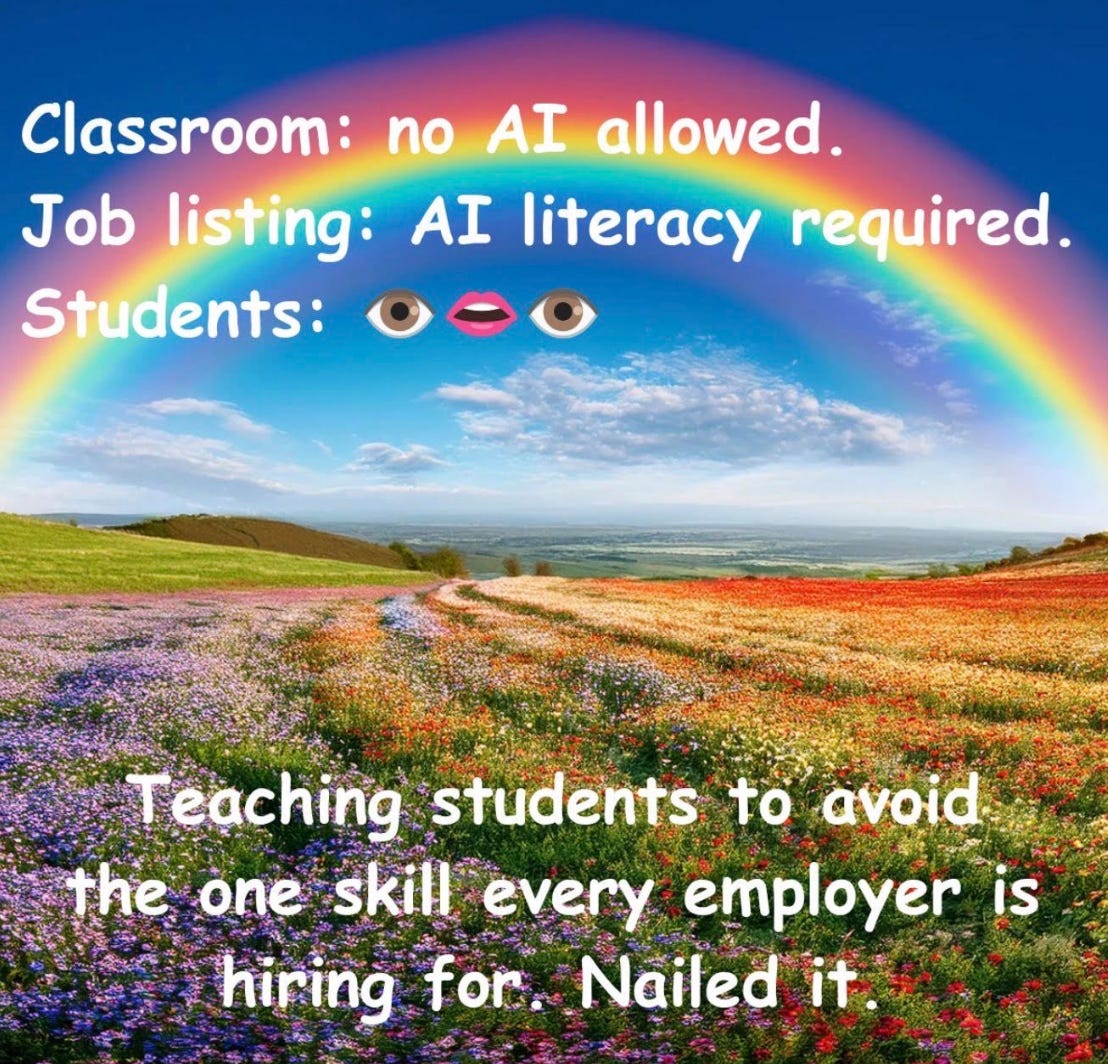
I wonder if the people who write these sorts of things have ever “used AI.”
I mean, clearly they have. Their text is almost always AI-generated and accompanied by AI-generated images. They know very well what the consumer AI landscape looks like. So then I wonder what they mean when they talk about “AI literacy” or “the necessary skills future employers are looking for.” And I wonder why they think this new literacy is so overwhelmingly urgent that it mandates scrapping every workable model of traditional instruction and replacing them with untested tech-centered class environments (which demonstrably harm students’ long-term retention and critical thinking skills).
It turns out that when the thought leader class talks about “AI literacy,” they mean: “prompting a chatbot.” That is basically it. There are some variations of this fundamental skill, like vibe coding (which also involves prompting a chatbot) or using more involved suites like OpenClaw (which involves a bit of additional prompting), but even those variations only apply to a small fraction of the student base targeted by the thought leader class. In most cases, “AI literacy” really means: “asking an agent for what you want and waiting for the agent to create it.”
Consumer AI chatbots are streamlined so efficiently, and they remove so much friction between client and software, that they are, in the best sense of the word, fool-proof. You have to actively try to get a useless result. If you know how to spell, and you know how to be specific, and you remember not to fall in love with your agent, then you have enough AI literacy to be employable in almost any sector that claims to demand AI literacy (with the exception of the high-level software engineering firms that actually design the software itself). It really is that easy. In fact, that’s the whole problem with AI in education—it’s too easy.
Motivated students can internalize the mechanics and limitations of every popular agentic model in the span of a single casual session. Most teenagers, even those whose teachers disallow the use of tech in class, have already figured it out on their own. Perhaps a little bit of metacognitive guidance from teachers would be useful here and there, but not nearly enough to justify jettisoning traditional instructional environments. If a student never saw or used an AI model until the weekend before their new job’s start date, they would probably be just fine. They may even be better prepared and higher functioning than their peers whose entire middle and high school experience was saturated by AI agents.
“AI didn’t ruin education—it only revealed the problems that existed all along.”
No. The mass-scale adoption of novel technologies did, in fact, introduce novel problems.
Which leads right into:
“It’s not the product—it’s the process” Or: “Measure the thinking, not the final result”
Take the oft-used complaint: “We used to grade students based on what they could produce (answers on tests, research papers, etc). Now that AI can produce those results just as well as students can, it’s clear that we need to measure student thinking instead of the final product. In fact, we should have been doing this all along.”
The situation has certainly changed. But there’s no reason to lie about how “awful” things used to be. There was never anythinginherently wrong with grading students based on “final products” or “artifacts.” Those final products and artifacts are the culmination and proof of student thinking. You can look at a research essay and pinpoint the exact moment and manner in which a student’s argument has gone off track. Thinking is baked into the writing process. The insinuation that past approaches to college assignments somehow failed to “capture student thinking,” is a neat little post-hoc way of feeling better about AI’s annihilation of trust in the modern classroom. It implicitly absolves students from their participation in the most extensive cheating epidemic in the history of American education. Of course students cheat now that they’re able to get away with it. The system was broken to begin with!
This is nonsense. The previous model (teacher teaches > student demonstrates understanding through independent work > teacher assesses independent work) is perfectly sensible. “Adapting” curricula to the existence of AI by getting rid of “final products” just means a retreat into lesser forms of learning. Almost every alternative to measuring student growth is far, far inferior.
Nils Gilman’s essay “The University as We Know it is Finished” is the best articulation this concern that I’ve seen. I disagree with his solutions, but his diagnosis is the fairest and most charitable out of all the reform cases out there. For Gilman, term papers are out, lectures are out, and anything involving knowledge transfer from teacher to student is functionally out. Instructors must become “facilitators,” as they are in the “Oxbridge tutorial system,” if they are to survive. The liberal arts, says Gilman, do have a bright future, so long as we shift our instructional focus in radical new directions:
“The replacement, as many education researchers are arguing, is live assessment and demonstration: real-time diagnosis of novel situations, design critique, structured adversarial debate, and Socratic examination. These formats test the ability to sense-make under pressure, defend a frame against live challenge, revise a model when evidence contradicts rather than confirms it, and recognize when uncertainty is too high to proceed. In practical terms: collaborative student projects will require documented decision logs tracing reasoning behind commitments, the canonical deliverable shifts from polished artifact to demonstrated live reasoning, and oral examinations and hand-written exams will become the primary assessment instruments. But despite this emerging consensus among education researchers, institutional practice has barely moved.”
All of this assumes that learning actually happens in these new modes. Socratic seminars, fishbowl discussions, project-based learning, personal reflections, classroom debates, oral exams – all of these are, allegedly, “AI-proof,” but all of them fall far, far short of what might be gained from good old-fashioned reading and writing assignments (which can, apparently, no longer be “trusted”). I’ve seen each of the alternatives listed above done well, but even at their sparkling best, they possess a fraction of the rigor that comes from sustained written work. It’s not even close. The process of researching and writing, say, a 20-page paper is an unexampled exercise of a young mind stretched to its fullest capacities, and it provides opportunities for a careful instructor to give feedback down to the smallest shifts of emphases in an argument— all the way down to the sentence and clause level. No “live critique” or classroom debate can match the capacity for subtle distinction in individual expression that comes about naturally through the writing process. If we are effectively removing long-form writing from instruction (and replacing it with, I suppose, “decision logs”), then we are removing the central pillar of humanities instruction. There is no substitute for writing, and we need to stop pretending that there is.
And anybody who thinks that AI won’t be able to intercede for a cheating student during these “live critique alternatives” (debate prep, or discussions, or “decision logs”) has simply not interacted with AI enough or has not met enough AI-native students. Most AI models can already handle even the most adaptive and personalized and spontaneous assignments of an “AI-proofed” classroom. Plug some documents into Google’s Notebook LM and select the “podcast” option and listen as two AI voices will plausibly stutter and “um” their way through a conversation in a way that’s virtually indistinguishable from human speech. Ask ChatGPT’s voice feature to interrupt your debate in real time and list your fallacies, and it will do so. Ask Claude to create a fictional chat log between you and the machine that “demonstrates your independent thinking,” spaced out over multiple realistic timestamps, and it will gladly acquiesce. There are always novel ways of cheating with AI. If you model your instruction entirely around what AI “cannot do,” you end up with very elementary levels of instruction in which students who want to cheat will end up cheating anyway.
I teach English. I assign papers. There is, quite literally, no other way to grow as a writer than to write. There was no pre-existing problem with English education that needed to be solved. There is no overriding reason to remove writing from the curriculum. All of this is stupid.
If the AI-driven cheating epidemic leads to the devaluing of college education (already in progress); if it produces generations of graduates with less functional literacy than their predecessors (already in progress); if it leads to the further marginalization or collapse of liberal arts programs or the shuttering of entire institutions (already in progress), then we shouldn’t lie about it or pretend like this had to happen. This was neither inevitable nor necessary. There is no silver lining that we have to pretend to embrace. AI came along and killed a good thing. It didn’t “open the door for exciting new opportunities”; it didn’t expose pre-existing problems in the education-industrial complex; it didn’t operate on the playful-but-ultimately-productive Silicon Valley model of “move fast and break things.” It killed things that were good and didn’t need to die.
“Progress” is catastrophic and always has been. Every new development — whether good or outrageously unnecessary — sacrifices what was good and wholesome in the old. Things happen. Things break. The paradigm shifts, and we shift with it. I have very few illusions about any of this and what it means for my chosen profession. I’m just lucky that I entered education when I did and that I’m not having my heart broken after decades of sacrifices, like so many teachers I know. Colleges were already facing bloat and a tuition crisis, and now it looks like they’ll be undone even sooner than that by the credentialing problem: the cheating epidemic has forever poisoned the reputation of the Bachelor’s degree. At the end of all this, we will have lost so, so much in our cultural life that truly matters to human flourishing.
So we go on. Colleges will change or they won’t. The arts and humanities will find new homes outside the academies. I’ll keep assigning essays and brace for the worst until I stop teaching. Students who are able to challenge themselves out of pure intrinsic discipline will succeed; those who don’t will struggle. I don’t have a rah-rah coda to the whole mess. I don’t, in fact, want to write about this again. The doomer case has been laid out brilliantly already. I want to move on. But I want, more than anything else, for the grifters and charlatans and salesmen cluttering LinkedIn and other forums to stop lying about the collapse of traditional learning. I want them, for once, to look their favorite creation squarely in the face and be honest about what it is doing to the world and the young people they claim to care about. Even Nero had the good taste to fiddle while Rome burned. If the fire broke out in 2026, perhaps he would be shelling out seminars on “fire literacy” and writing posts shaming the close-minded fire brigades for trying to save the wreckage. “They’re not just putting out fires — they’re putting out opportunities.”
Follow me on my new Substack: https://substack.com/@theprocrastinatingpoet
 The Procrastinating Poet